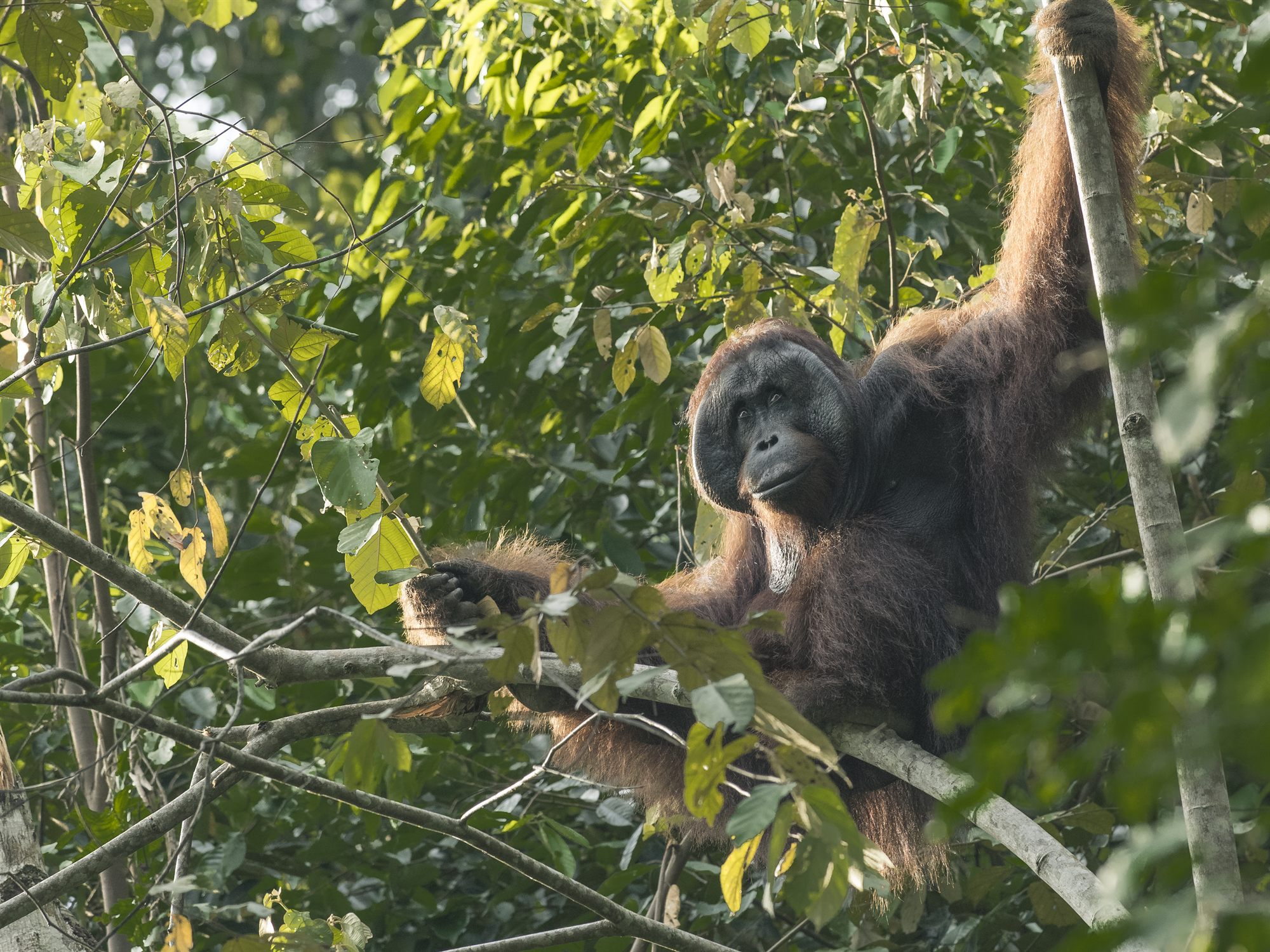
Flanged male Bornean orangutan.
A free field guide to the wildlife of Borneo, covering 1,309 core vertebrate species — 678 birds, 239 mammals, 166 snakes, 122 frogs and caecilians, 86 lizards, and 18 turtles and crocodilians — plus 2,427 more across moths, butterflies, dragonflies and arachnids. Every species has its scientific name, its Malay and Indonesian names, and a link to the reserves and rivers where it is actually seen, and most have photographs. There is nothing to buy and no account to create.
What's covered
Ten sections, each a complete list for its group, not a selection of highlights.
Birds of Borneo — 678 species
The full Bornean list including around 60 endemics, from Bornean bristlehead and the Whitehead's trio to the hornbills, pittas, broadbills and the babblers that make up the bulk of a real day list.
Mammals of Borneo — 239 species
Orangutan, proboscis monkey, elephant and sun bear, plus the five wild cats, the civets, pangolin, colugo and tarsier — and the full list of 89 bats and 66 rodents alongside them.
Frogs of Borneo — 122 species
Wallace's flying frog, the horned frogs, the tree frogs and the litter and stream frogs. The easiest group to actually find, and the one most visitors are least equipped to name.
Snakes of Borneo — 166 species
King cobra, reticulated python, the Bornean endemic pit vipers, the gliding tree snakes and the long list of colubrids that look far more dangerous than they are.
Lizards of Borneo — 86 species
Ten Draco flying lizards, the geckos, the skinks, the monitors, and the Bornean earless monitor.
Turtles & Crocodiles of Borneo — 18 species
Saltwater crocodile and false gharial, plus the freshwater turtles and terrapins, most of which are in serious trouble.
Moths of Borneo — 1,250 species
The giant Atlas moth and the hawkmoths, plus the huge Erebidae and Geometridae families that dominate any night's light sheet.
Butterflies of Borneo — 667 species
Rajah Brooke's Birdwing and the rest of the swallowtails, plus the blues, coppers and hairstreaks that make up most of the real list.
Dragonflies of Borneo — 376 species
Hawkers, darners and skimmers over open water, and the endemic jewels and torrent damsels that mark a healthy forest stream.
Arachnids of Borneo — 134 species
Huntsman spiders, orb-weavers and earth tiger tarantulas, plus the island's scorpions, whip spiders and whip scorpions.
More field guides — covering the rest of Borneo's insects — are coming.
Is this better than a printed field guide?
No — for actual identification, a good printed guide still beats this. Illustrated plates, detailed written descriptions and decades of accumulated fieldwork go further than a phone screen and a photo, and a book never runs out of battery or needs a signal. This site is free, lighter to carry, and useful for a quick check in the field or a link straight to where a species is actually recorded — a companion to check first, not a replacement for the guide you read properly the night before. A few of the standouts, worth owning outright:
Recommended printed guides
For birds, Phillipps' Field Guide to the Birds of Borneo by Quentin Phillipps, illustrated by Karen Phillipps, is the standard carry for serious birders on the island, and Susan Myers' Birds of Borneo is a strong photographic alternative. For mammals, Phillipps' Field Guide to the Mammals of Borneo (Quentin Phillipps and Karen Phillipps, building on the earlier Payne & Francis guide) is the one to own. For reptiles, A Field Guide to the Reptiles of Borneo by Robert Stuebing, Robert Inger and Bernard Lardner remains the reference. For frogs, A Field Guide to the Frogs of Borneo by Indraneil Das and Alexander Haas is the closest thing to a definitive guide for the group. None of these are cheap or easy to find outside Malaysia — order ahead of a trip rather than hoping to find one on arrival.
Using it in the field
Open the site on your phone and add it to your home screen — on iPhone, the share button then "Add to Home Screen"; on Android, the browser menu then "Install app" or "Add to Home screen". It then opens like an app, full screen, and the guide itself loads without a connection.
Be realistic about offline on the website: the text and species lists are cached, but the photographs are not, so a species page you have never opened will show its text without images when you have no signal. Deep in Danum or Deramakot you will have no signal. If you know which animals you are chasing, open their pages while you still have a connection — or install the Android app and use “Download Full Pack” before you travel, which stores the photographs on your device so they are there whether or not you thought to open the page first.
Two other things worth knowing before you go. The trip planner lets you save regions and species into an itinerary you can export as a PDF or send to an operator. My sightings keeps a running list of what you actually saw, on your device only.
Frequently asked questions
Is the Borneo field guide free?
Yes. Every species page, photograph and location page is free to use, with no account, no signup and no paywall.
How many species does it cover?
1,309 core vertebrate species — 678 birds, 239 mammals, 166 snakes, 122 amphibians, 86 lizards, and 18 turtles and crocodilians — plus dedicated guides to 1,250 moths, 667 butterflies, 376 dragonflies and 134 arachnids.
Can I use it offline in the forest?
Two ways, and they are not equally good. Adding this site to your phone's home screen opens the guide without a connection, but photographs are not stored, so pages you have not already visited will show text without images when you have no signal. The free Android app is the better option for real offline use: it carries a set of species photographs inside it, and “Download Full Pack” stores the rest on your device, so pages keep their images deep in Danum or Deramakot where there is no signal at all. An iOS version is coming.
Do I still need a printed field guide?
Yes, if you are serious about identification. Printed guides give illustrated plates showing every plumage, written descriptions and distribution detail no website has replicated, and a battery that never runs out. This is a free, lighter companion to check in the field, not a replacement.
Where to start
If you are planning a trip, start with the regions guide — it covers every site we cover across Sabah, Sarawak, Brunei and Kalimantan, and each one lists the species you can realistically expect there. If you are chasing mammals specifically, the mammal watching guide is a much longer read on how the night drives are actually run and what equipment changes your odds. If you already know what you are looking for, go straight to search.