 Wildlife
of Borneo
Best place to see Bornean Bristlehead
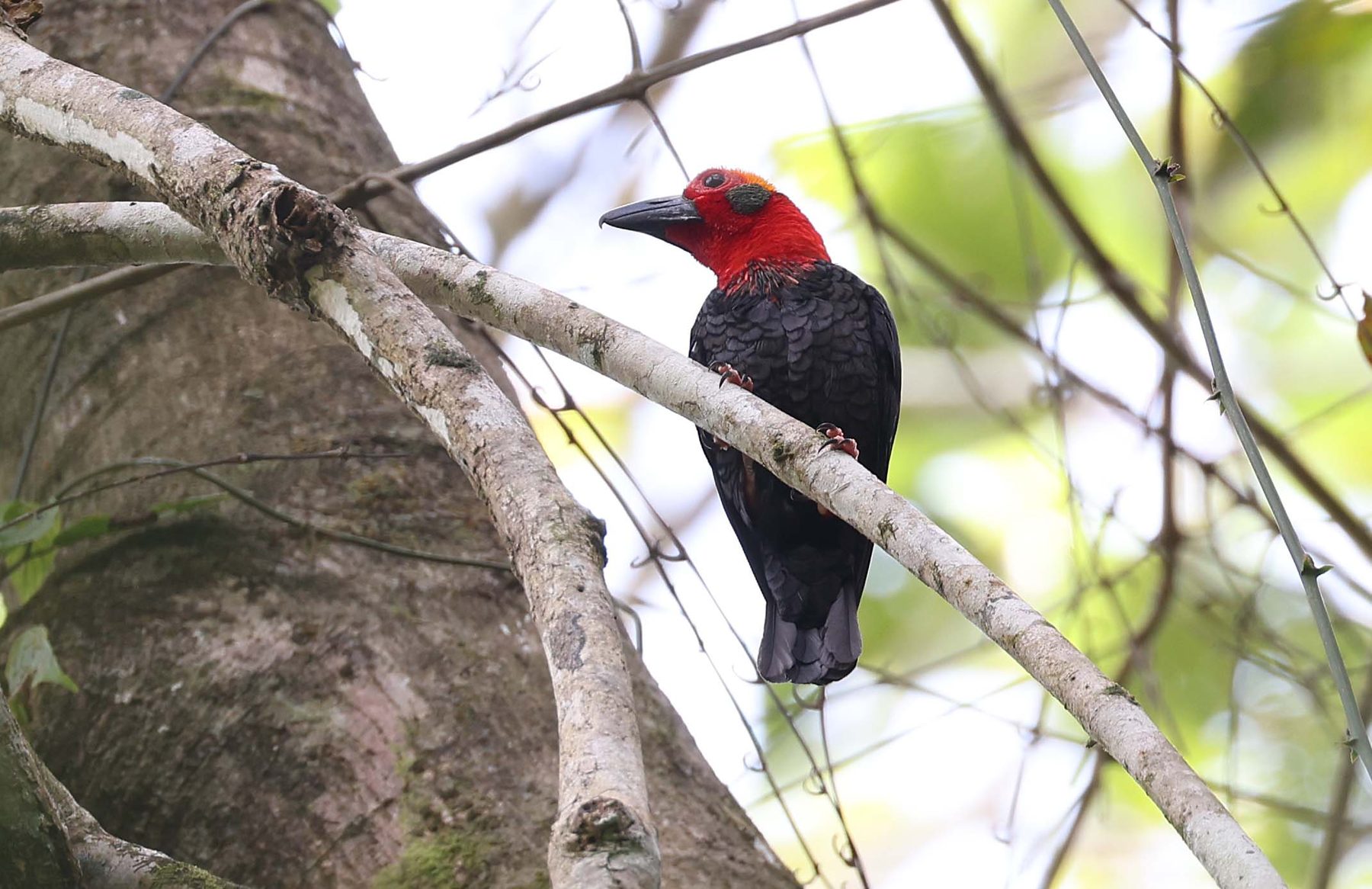
Bornean Bristlehead, Tabin. Photo: Chris Townend, Wise Birding Holidays.
The short answer: the best place to see a Bornean Bristlehead is Nepenthes Camp in Maliau Basin, where the stunted heath forest keeps the birds low — but it is a hard trek. Danum Valley and Deramakot give regular sightings, and the Rainforest Discovery Centre at Sepilok is the lowest-effort option, with occasional eye-level views from its canopy walkway. The bristlehead is a Borneo endemic and the only living member of its family, which is why it tops so many wish lists. Below: where to go, what to expect at each place, and a deep dive into the bird itself.
Video: a bristlehead at Danum Valley, by Live2Bird on YouTube.
Where to see it, at a glance
Easiest: Rainforest Discovery Centre, Sepilok — a day visit, no trek, sometimes eye-level from the walkway.
Regular sightings: Danum Valley (Field Centre, Borneo Rainforest Lodge or Langom) and Deramakot.
One of the best, but hardest: Nepenthes Camp, Maliau Basin — low-canopy kerangas forest, and a difficult multi-day trek to reach it.
No site guarantees it. Bristleheads travel in wandering flocks, so even the best place can give you a blank morning and the same trail the next day can give you a family party at eye level. Plan for more than one morning wherever you go.
Rainforest Discovery Centre, Sepilok: the low-effort option
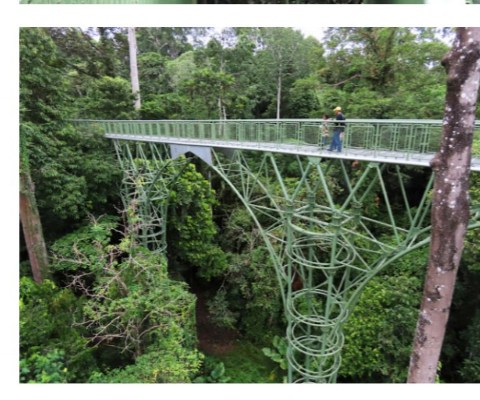
The canopy walkway at the Rainforest Discovery Centre. Photo: 1Stop Borneo Wildlife.
If you want the bird without a long journey, start here. The Rainforest Discovery Centre (RDC) sits next to the Sepilok orangutan sanctuary, a short drive from Sandakan, so you can do it as a day visit from town. There is no trek and no overnight commitment. Its suspended canopy walkway and towers — more than 600 metres of walkway after the extension completed in 2022, rising to roughly 25 metres — put you into the tree crowns, which is the whole point with a canopy bird.
Bristleheads are regularly mentioned as one of the walkway's headline birds, and when a flock comes through at the right height you get what is almost impossible from the ground: eye-level views. It does not always happen. Some mornings the flock passes high and away; some mornings it does not come at all. Go early, walk slowly, listen for the nasal chatter, and stop where the walkway reaches the larger crowns rather than hurrying to the end. If you are combining orangutans and a bird target in one outing, nothing else in Sabah is as convenient. See the Sepilok page for the wider area.
Danum Valley: seen from every place you can stay
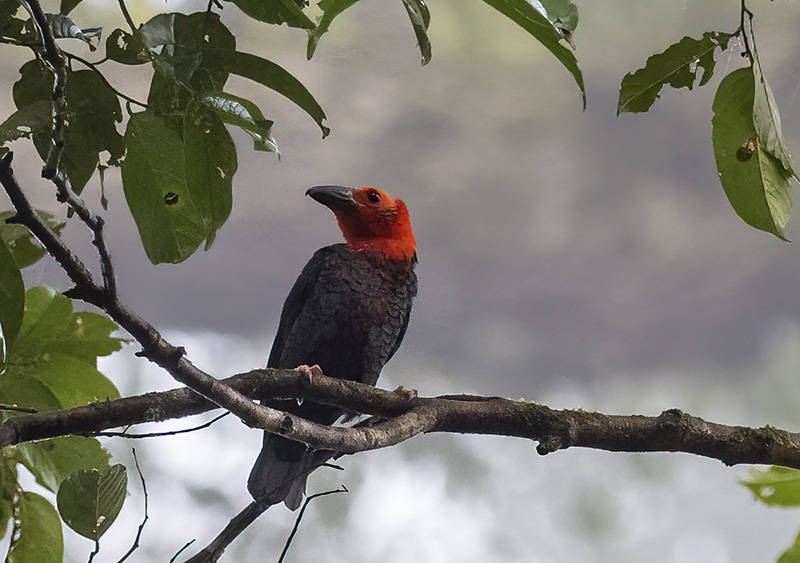
Bornean Bristlehead, Danum Valley. Photo: Ken Behrens, Tropical Birding.
Danum is the classic answer, and it earns it: unlogged lowland dipterocarp forest, a big enough area for bristlehead flocks to range widely, and sightings reported by guests at all three places you can stay — the Danum Valley Field Centre, Borneo Rainforest Lodge and the newer Langom Research Station on the edge of the conservation area. You do not need a particular lodge to be in with a chance; you need time, and a guide who is listening for the flock.
The choice between them is mostly about budget and style. The Field Centre is the basic, research-oriented option; Borneo Rainforest Lodge is the upmarket one, with its own canopy walkway; Langom is the newer, quieter base that also runs night-drive roads in the style of Deramakot. At Danum the birds are usually high, so expect neck-craning views of a red head against bright sky unless the flock drops to a fruiting tree or you are up on a walkway. See the Danum Valley page for how to book.
Deramakot: regular sightings, and the night drives as a bonus
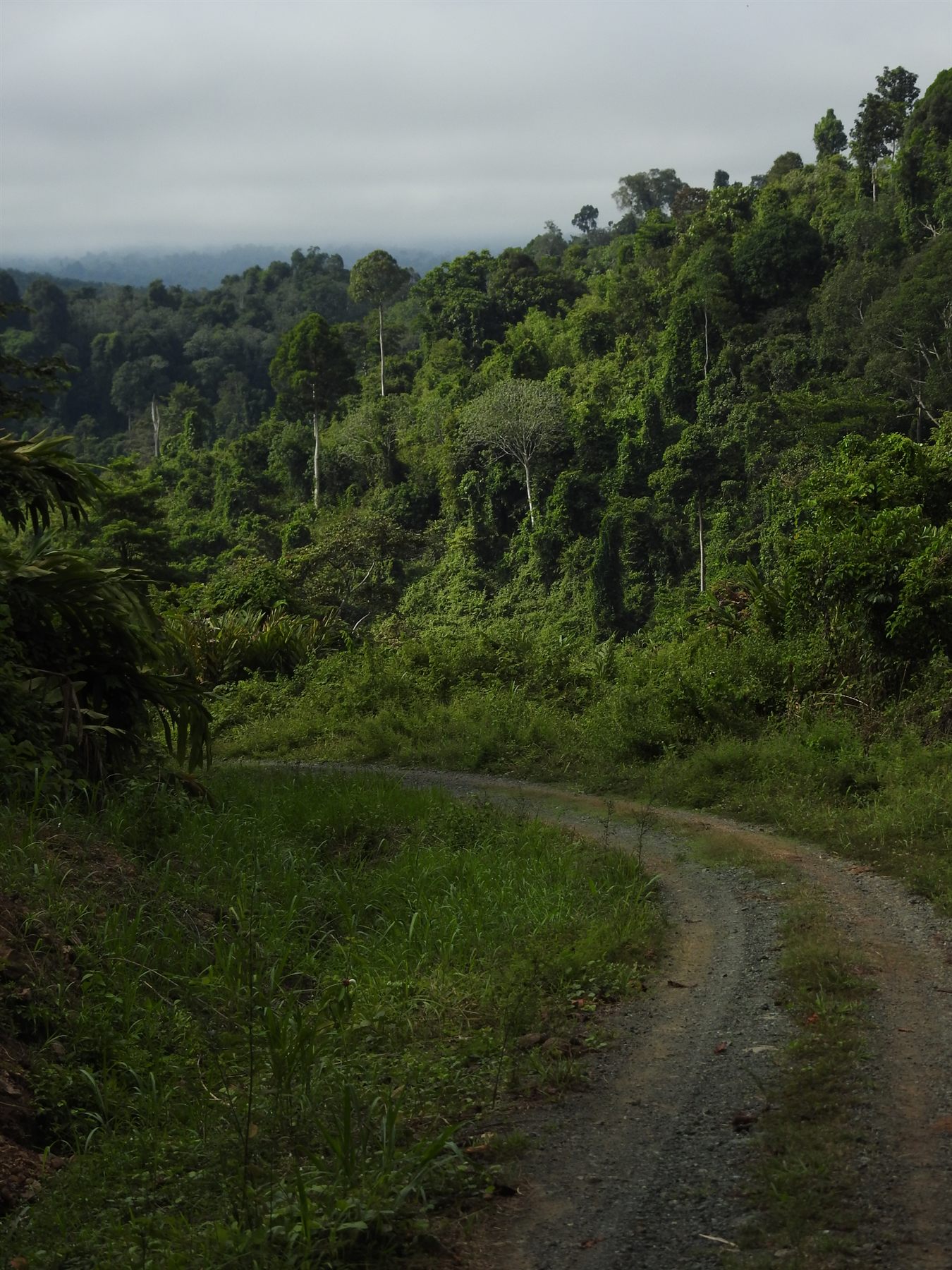
Forest roads at Deramakot. Photo: Tomer Ben-Yehuda.
Deramakot is best known for mammals — marbled cat, leopard cat, clouded leopard and more on its night drives — but by day it has regular bristlehead sightings. It is a managed, certified forest rather than an untouched one, with open roads that give you sightlines into the mid-storey that closed forest does not. That is a real advantage with a canopy bird: you can often watch a flock cross a road or work a roadside tree rather than catching a glimpse through leaves.
The practical point is that a Deramakot stay is already built around getting out in vehicles at the right hours, so the bristlehead becomes a morning bonus on a trip you would be taking anyway. Slots are limited and book up, which is exactly why Langom (above) exists as an alternative.
Nepenthes Camp, Maliau Basin: one of the best — if you can get there
For many people who have seen it, Nepenthes Camp is one of the very best places. The reason is the forest. Up on the basin rim the habitat shifts to kerangas — stunted heath forest on poor, sandy soil, with pitcher plants everywhere — and the canopy there is low. A bristlehead flock that would be forty metres up and backlit in lowland dipterocarp forest is, here, much closer to eye level. It is the same bird, in a setting that finally lets you look at it properly.
It fits what is known of the bird: it has been recorded in upland kerangas and, at Maliau, up to around 1,000 metres, well above its usual lowland range. Nepenthes Camp itself sits at roughly 950 metres.
The caveat is the trek, and it is not a small one. Typical itineraries quote around 7.5 km from Agathis Camp to Nepenthes Camp, five to six hours on foot for fit walkers, with the first couple of kilometres steeply uphill. The camp is basic — bunk beds and limited electricity — and you are committing to a multi-day trip, not a morning. Be honest about your fitness and your knees. If you cannot or would rather not do it, Danum and Deramakot give you a very good chance without the suffering. If you can, read the Maliau Basin page and book through an operator who knows the route.
How to find one when you are there
Listen first. Bristlehead flocks are noisy and nearly continuous callers — nasal whining contact notes, chattering, whistles and honks — and you will usually hear them well before you see them. Learn the sound before you arrive; the species page and the recordings on xeno-canto are a good start.
Look for the flock, not the bird. They travel in parties of roughly six to ten, moving slowly and heavily through the mid and upper canopy and feeding along large horizontal limbs. They sometimes join mixed-species flocks, so a burst of activity — drongos, malkohas, babblers, woodpeckers — is worth following.
Be there early. As with most Bornean forest birds, the first two hours after dawn carry most of the activity. Use the middle of the day for rest and go back out late afternoon.
Go easy on playback. This is a Vulnerable species at sites where many groups pass each week. Follow the guide's and the park's rules, and see the playback notes in the birdwatching guide.
The Bornean Bristlehead: a deep dive
A family of one
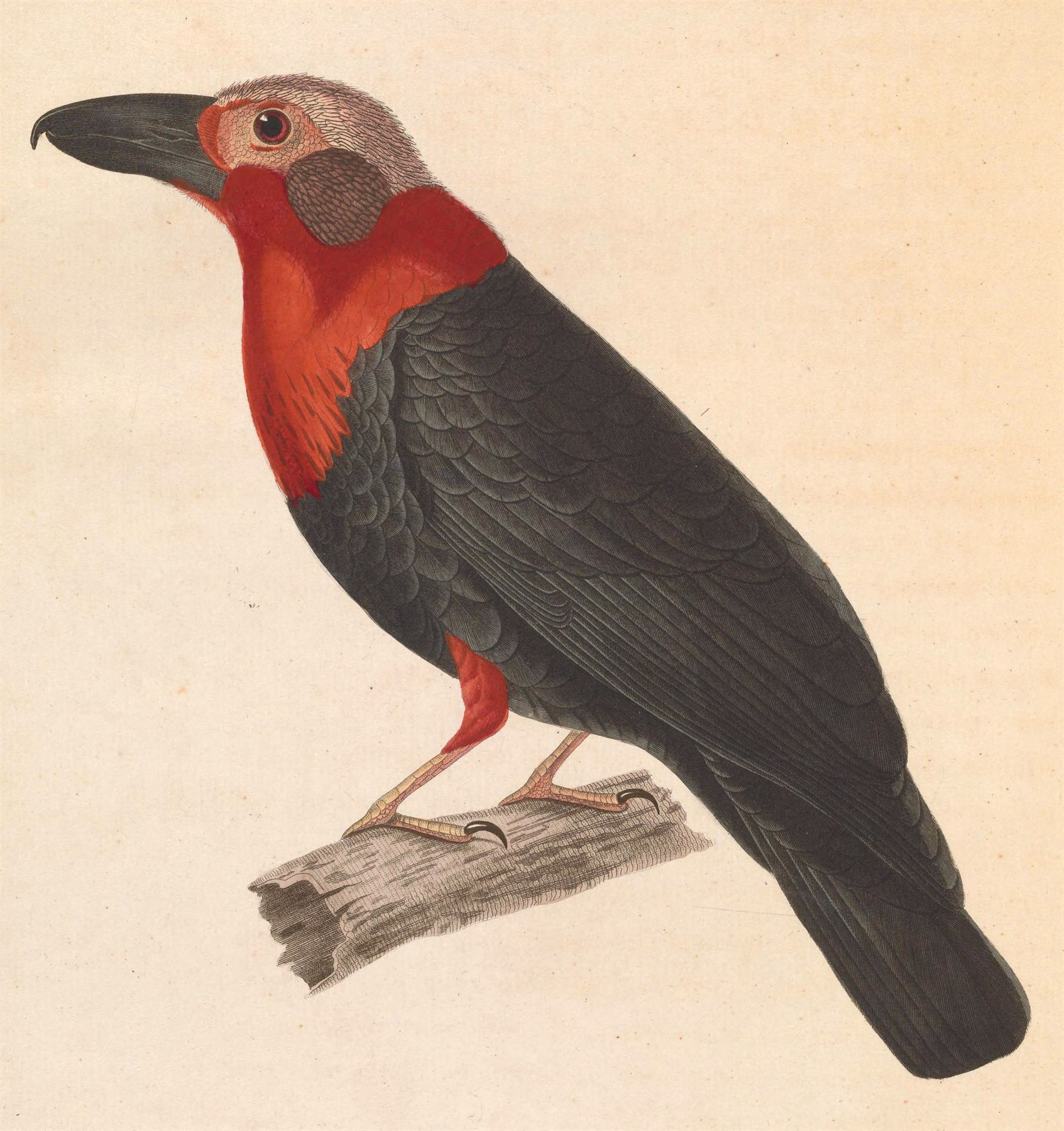
An 1838 plate of the bristlehead. Public domain.
The Bornean Bristlehead (Pityriasis gymnocephala) is the only species in its genus and the only species in its family, the Pityriasidae. It was described scientifically in the 1830s, and ornithologists have argued about where it belongs ever since. It has been filed with the helmetshrikes, the butcherbirds, the woodswallows and even the crows; a more recent proposal links it to the woodshrikes and flycatcher-shrikes. Its closest relatives are still debated. In practical terms that means there is no near cousin anywhere to give you a second chance — if you want the bird, you have to come to Borneo.
What makes it look so strange
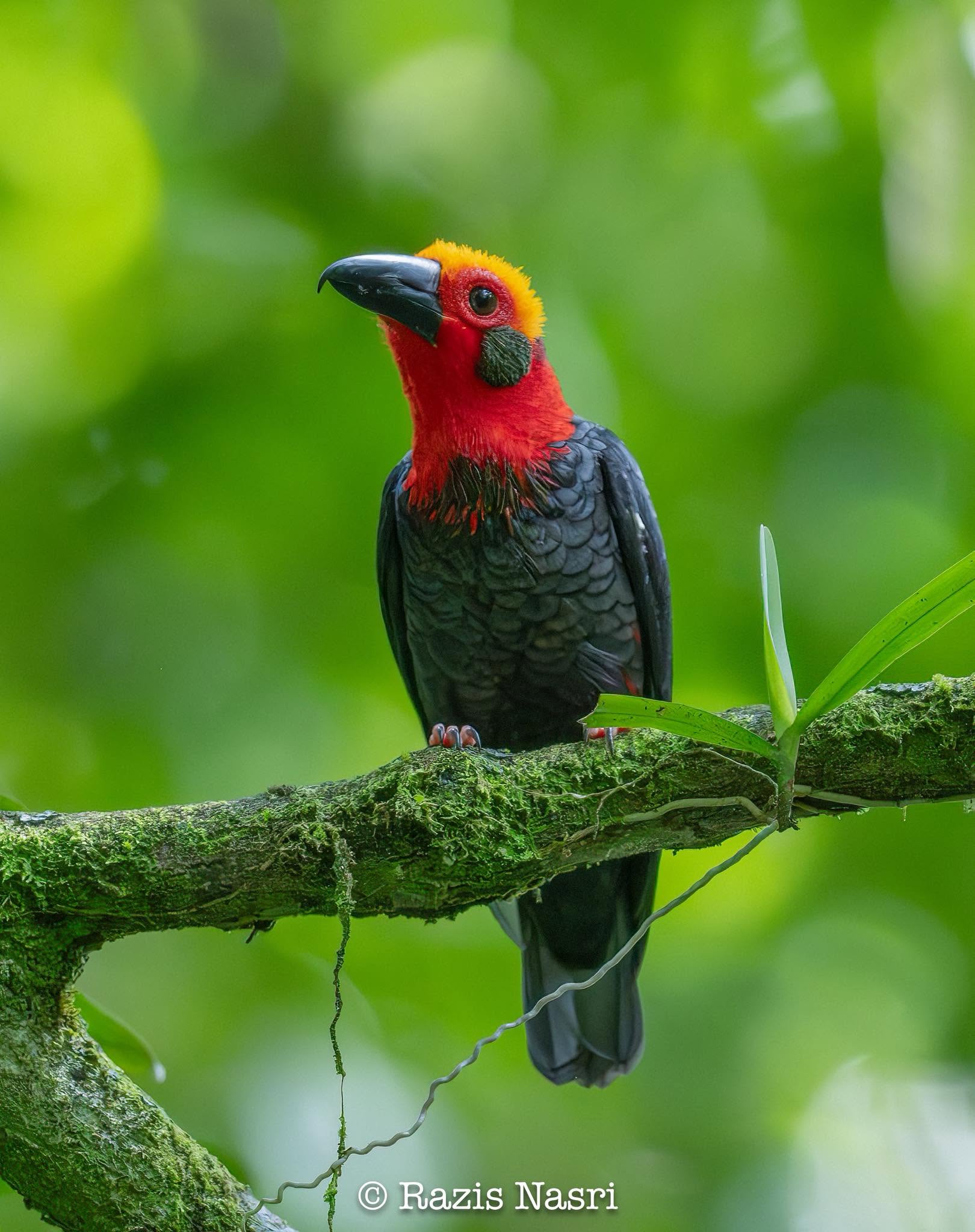
Photo: Razis Nasri (RN Empire Travel & Tours).
It is a chunky, short-tailed bird about 25 cm long, mostly black, with a red head, throat and neck, a grey ear patch, and a massive hooked black bill. The crown is bare skin, deep yellow, covered in tiny bristle-like projections three to four millimetres long. That is the origin of both names: the genus name comes from a Greek word meaning "dandruff", and the species name means "bald-headed". Red patches on the thighs, and in many females on the flanks, add to the effect, and a white patch at the base of the flight feathers shows as the bird crosses a gap. Juveniles are duller, with black thighs and undeveloped bristles.
How it lives
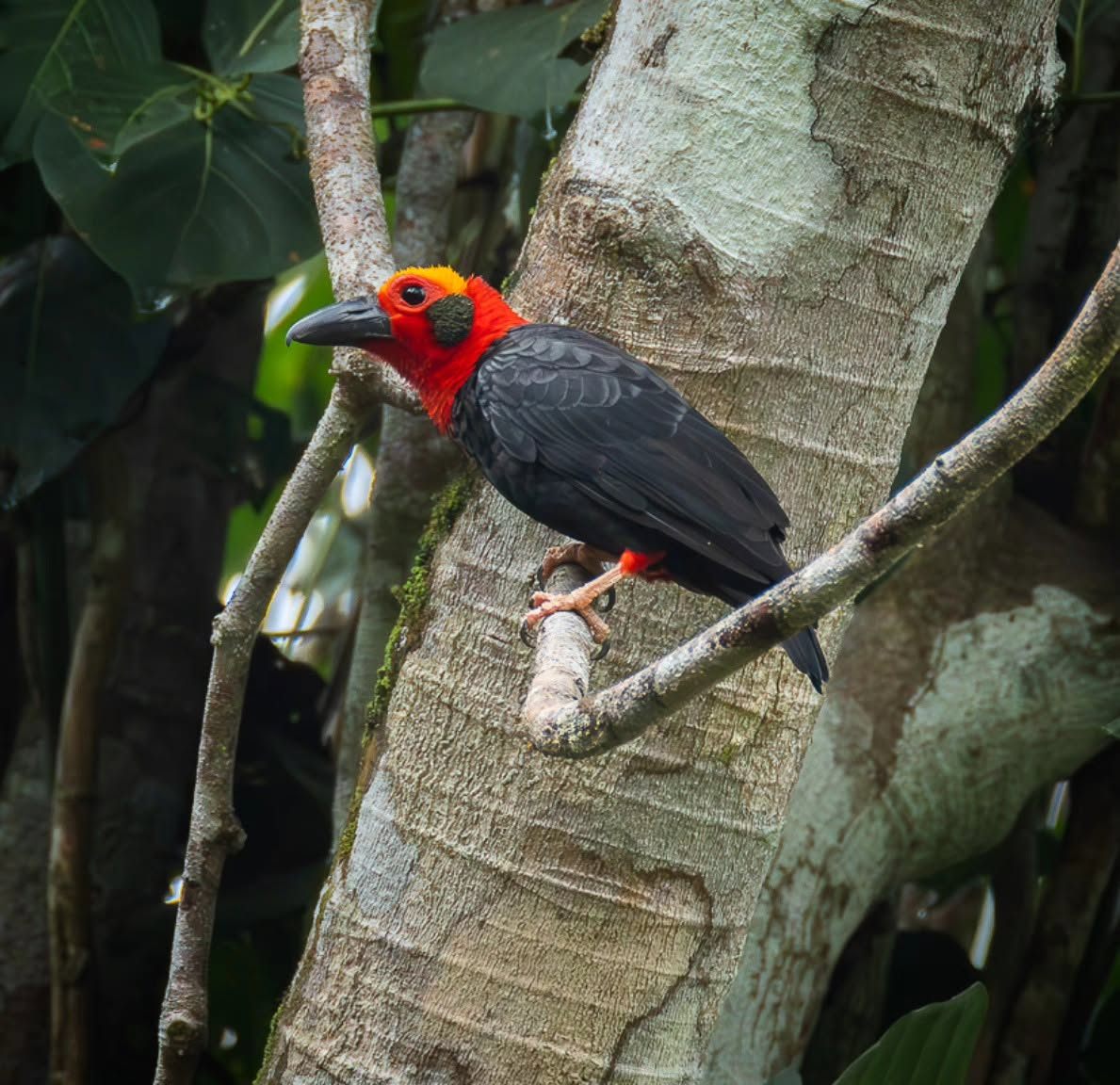
Photo: Nick Brierley.
Bristleheads are sociable and noisy, moving in small flocks of up to about ten in the canopy, often feeding along thick horizontal limbs and calling almost continuously. They eat mainly large insects and other arthropods gleaned from foliage, twigs and trunks, taking small vertebrates such as lizards and frogs and, occasionally, fruit. Their flight is a fast, shallow wing-beat, and on the move they look slow and heavy.
Remarkably little is known about their breeding. The nest has been barely described, egg records are very few, and observations of more than one female feeding a single fledgling hint at some form of communal breeding. For a bird this conspicuous, that is a surprising gap — and part of why the species is considered so special.
Why it is so sought after
Several things combine. It is a family of one, which is a prize in itself for anyone who counts bird families. It is a Borneo endemic, so it cannot be seen anywhere else. It is visually bizarre: red head, yellow bristles, hooked bill, glossy black body. And it is genuinely hard. It lives high in lowland forest, travels in nomadic flocks that wander widely and turn up unpredictably, and is heard far more often than it is seen. Many birders visit Borneo several times before connecting with one.
There is a conservation edge too. The bristlehead is classed as Vulnerable. The lowland forests it depends on, including peat swamp forest, continue to be cleared and burned, and because the flocks wander so widely its true numbers are difficult to estimate. Seeing one in a well-protected site such as Danum, Deramakot or Maliau is a reminder of what those places are protecting.
Common questions
Where is the best place to see a Bornean Bristlehead?
Nepenthes Camp in Maliau Basin is one of the best, thanks to the low kerangas canopy, but the trek is hard. Danum Valley and Deramakot give regular sightings, and the Rainforest Discovery Centre at Sepilok is the easiest.
What is the easiest place to see one?
The Rainforest Discovery Centre near Sepilok. No trek, no overnight stay, and the canopy walkway sometimes gives eye-level views. Nothing is guaranteed.
Is the Bornean Bristlehead rare?
It is classed as Vulnerable. It lives only in Borneo, relies on lowland forest that is still being lost, and its flocks wander widely, so it is hard to count and hard to predict.
Why is it so sought after?
It is the only member of its bird family, found nowhere outside Borneo, with a striking red head, bare bristled crown and heavy hooked bill — and it stays high in the canopy, so many birders go years without seeing one.
What does it sound like?
Nasal whining contact notes, harsh chattering, whistles and honks. Flocks of six to ten call almost constantly, and the noise is often the first sign they are close.
Related guides
The full Bornean Bristlehead species page has the photos and call. For wider planning, see the birdwatching guide, the bird hides of Sabah, and two trip reports with bristlehead sightings: Sabah Birding, April 2026 (Tabin) and Broadbills & Bristleheads, 2022 (Danum). Operators who run dedicated birding trips are on the tour operators page.
Pick the places you want to visit and the species you want to look for, then send the finished plan straight to an operator.