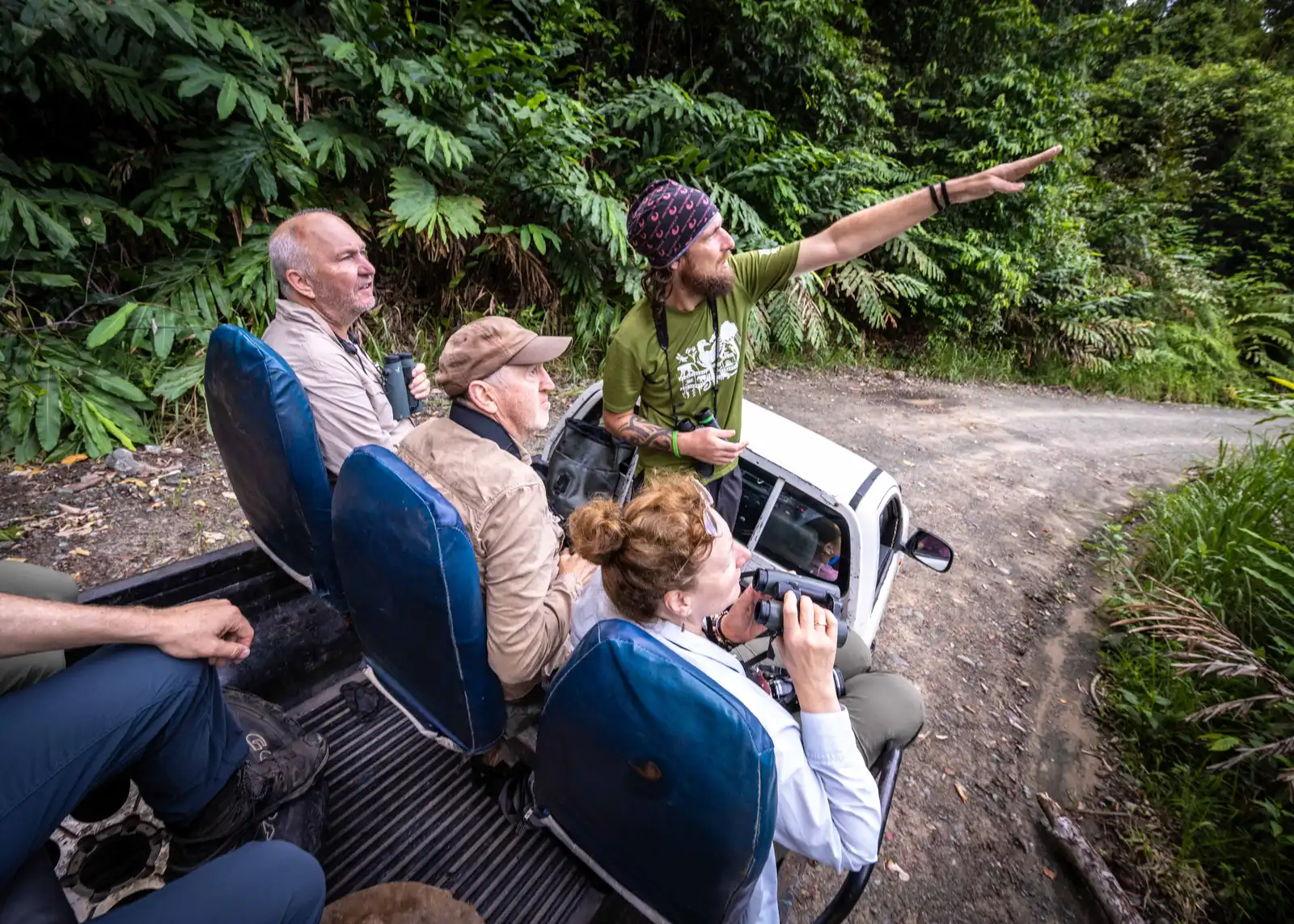
Mike Gordon spotting from the back of the truck, Deramakot Forest Reserve. Photo Charles Hood.
A Bay Cat crossing the road at night, and a long-awaited Sun Bear at last: Jon Hall's July 2022 report for mammalwatching.com covers two weeks across Deramakot Forest Reserve, Mount Kinabalu National Park and Sayap Substation with a group of seven, led by our own Mike Gordon for Adventure Alternative Borneo. 52 species, 13 lifers, and one of the rarest cats on Borneo.

Trip report by Jon Hall, mammalwatching.com
Below is Jon Hall's trip report in full, from mammalwatching.com — in his own words. Photos by Jon Hall, Charles Hood and Ian Thompson, used with permission.
Karen Baker, Mike Gordon (leader), Jon Hall, Charles Hood, Phil Telfer, Ian Thompson, Tracey Watchurst.
Some people are guided by a set of core values. Others turn to religious beliefs or focus on doing all they can for their family or loved ones. I turn to my Top 21 Species To See List.
Before I returned to Borneo last month no fewer than four of my 21 most wanted list were easiest to find on Borneo: Sun Bear, Marbled Cat, Otter Civet and any Linsang species. And a fifth — the fabulous Tufted Ground Squirrel — is endemic. Meanwhile Clouded Leopard tops my 21 Species I To See Again list (yes I have a list for that too). So a return to Borneo was more destiny than choice.
Ian Thompson wrote an excellent account of our 2 weeks there. I wanted to add a few reflections on the three areas we visited and the mammals we saw.
Setting an Itinerary
This was my fourth trip to Borneo. Most of us had been before so I picked an itinerary focused on our key target species rather than seeing as much as possible. Any first time visitor to Borneo ought to visit the Kinabatangan River and Gomantong Caves for example.
We settled on eight nights in Deramakot Forest Reserve to focus on Clouded Leopard, Marbled Cat, Sun Bear and Otter Civet. Three nights on Mount Kinabalu to look for Banded Linsang. And two nights at the end to see if we could turn up a Tufted Ground Squirrel at Sayap Substation on Kinabalu (a long shot but worth a try).
One of the more difficult decisions we had to face was whether to focus our lowland rainforest time on Deramakot exclusively or also visit parts of the Danum Valley or Tabin. Though there are variations in what species you are more likely to encounter in each area I am not convinced that any one lodge or park is better or worse than any other for our target carnivores. Clouded Leopards, Marbled Cats and Sun Bears can be seen anywhere. Deramakot has several advantages over some of the other sites in that there are few restrictions for hard core mammalwatching and Mike Gordon knows it like the back of his hand.
Having said that when I go back I will likely try a few days somewhere else: it might not improve my odds for a Marbled Cat or Clouded Leopard but it might open the door to a few new species like Thick-spined Porcupine which seem uncommon in Deramakot.
Mike Gordon and Adventure Alternative Borneo
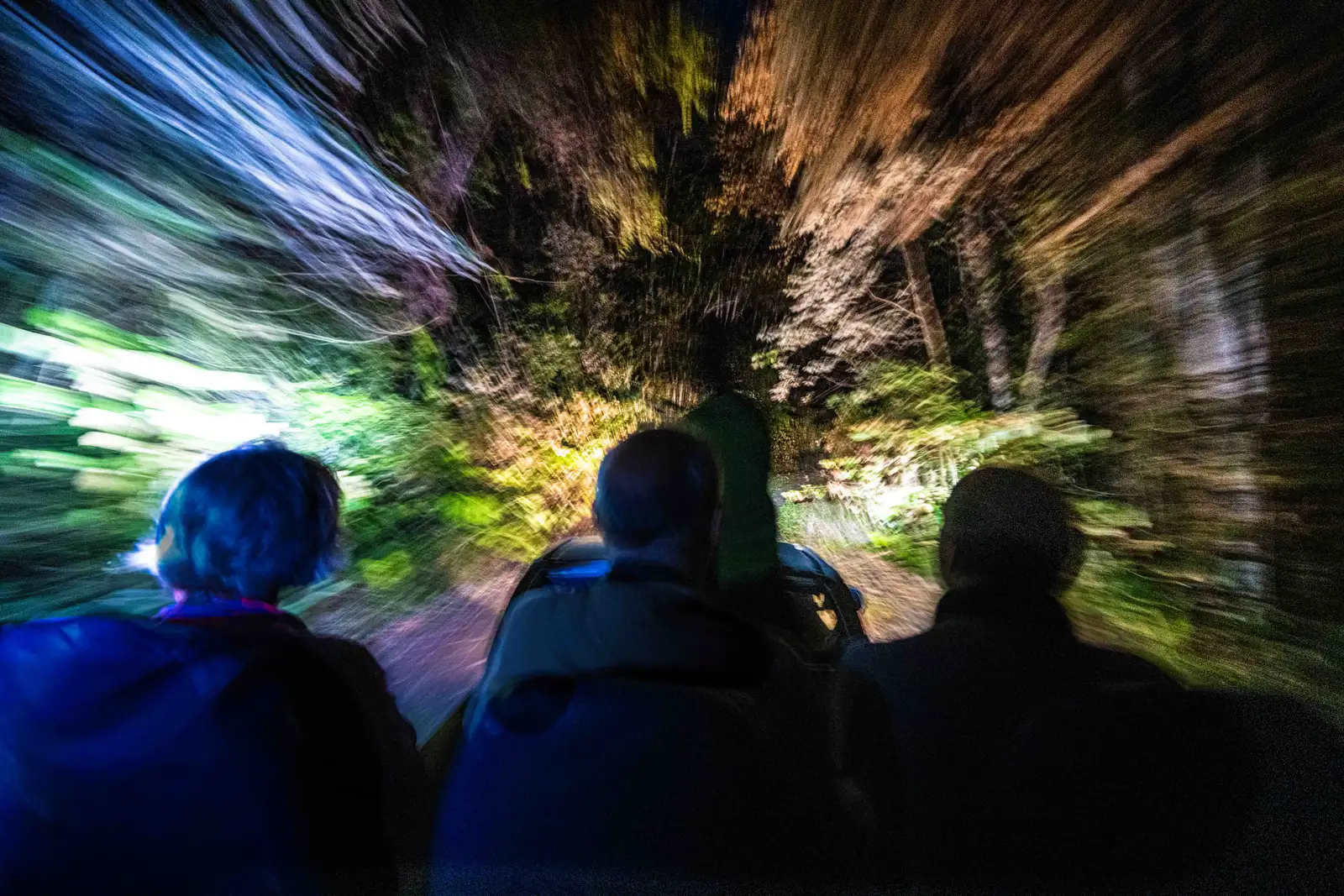
Night drive, Deramakot Forest Reserve. Photo Charles Hood.
We set the trip up with Adventure Alternative Borneo who put Deramakot on the mammalwatching map 8 or more years ago. They know the rest of Sabah well too, give honest advice and put an emphasis on setting up trips that are affordable. Mike Gordon is one of AAB's leaders.
Mike Gordon is a legend. I first met him back in 2015 when he was fairly new to the spotlighting game. I was impressed then by his enthusiasm and willingness to stay out all night and stay focused with seemingly superhuman powers of concentration.
Seven years later the enthusiasm and focus are as strong as ever: he can pull a spotlighting all-nighter and 9 hours in still be seeing roosting bats and stationary mice. But his superpowers have expanded: he is now extremely skilled in spotting and immediately identifying the wildlife of Deramakot in particular. I'm a fan of heat scopes but they are no match for Mike. On balance he was a more effective and efficient finder of interesting mammals than my thermal scope. For every one interesting species I found in my thermal scope that Mike had missed, we wasted time investigating ten sleeping birds, glowing cicadas and hot fruit. So I turned off my thermal scope and left it to Mike.
Mike's trademark spotlighting dance from the back of the truck is about as tough on his body as going ten rounds as a UFC fighter. He moves like a French mime clown on amphetamines. But it ensures he covers as much forest as is humanly possible while simultaneously processing whether each set of eyeshine is worth a second look or yet another flying squirrel, civet or loris. He was spot-on with every ID call he made by the way. It just took us several days to fully trust him and stop checking each squirrel for ourselves. Shame on us.
Oh and he's also very good company with thoughtful perspectives and funny stories on life in Borneo and beyond, even if we didn't have much time for chit chat.
Deramakot Forest Reserve
Deramakot is a large forest reserve that takes about 4 hours to reach from the nearest airport at Sandakan. Warning: it took Malaysia Airlines three attempts to land our plane at Sandakan. The pilots blamed strong winds, though the grass along the runway wasn't even swaying. It's been a long time since most passengers clapped when our plane landed. Even longer since I wanted to join in.
The reserve is managed as a commercial forestry operation but, according to Mike, the logging is done selectively and with great care and a myriad of rules are meticulously followed. So Sabah is proud of its example of how logging and conservation can go hand in hand. You can barely tell which areas have been logged recently and which have not.
Food and Accommodation
The headquarters, in the middle of the reserve, is a comfortable area to be based in. There are several guest bungalows each with two or three bedrooms that have ensuite bathrooms, hot water and good air conditioning. The dining room churns out tasty food three times a day with several dishes to choose from. We could decide our own meal schedule and influence the menu (though if you expect to have your dinner at 11pm one night — as we did — the kitchen might politely push back). They usually have beer for sale. My cellphone worked there and you can buy wifi through the office.
The Mammalwatching Set Up
The only limitation on mammalwatching in Deramakot is your stamina. If you want to spend 24 hours every day in the forest it could be arranged (though not all with the same guide and driver). Adventure Alternative Borneo included 7 hours per day of vehicle use in our quote, but we could pay for extra in advance. We bought an additional 15 hours of car time which turned out to be exactly what we needed for our 8 days.
Nearly all of the mammalwatching is done from the back of a pick up and, given our target species, we quickly moved into full nocturnal mode, only getting back into something closer to a diurnal routine for our last day or two in the park (by which I mean night drives ended at 1am rather than 5am). I don't know if the 12 hour time difference from the USA made this easier or harder to adjust to. But it's fair to say it wasn't the most relaxing schedule though it was entirely self-inflicted. For the first week I did not sleep more than 4 hours straight until I realised I would likely survive if I skipped lunch some days and chose to sleep through it. I survived, though I missed pizza one day which was a blow.
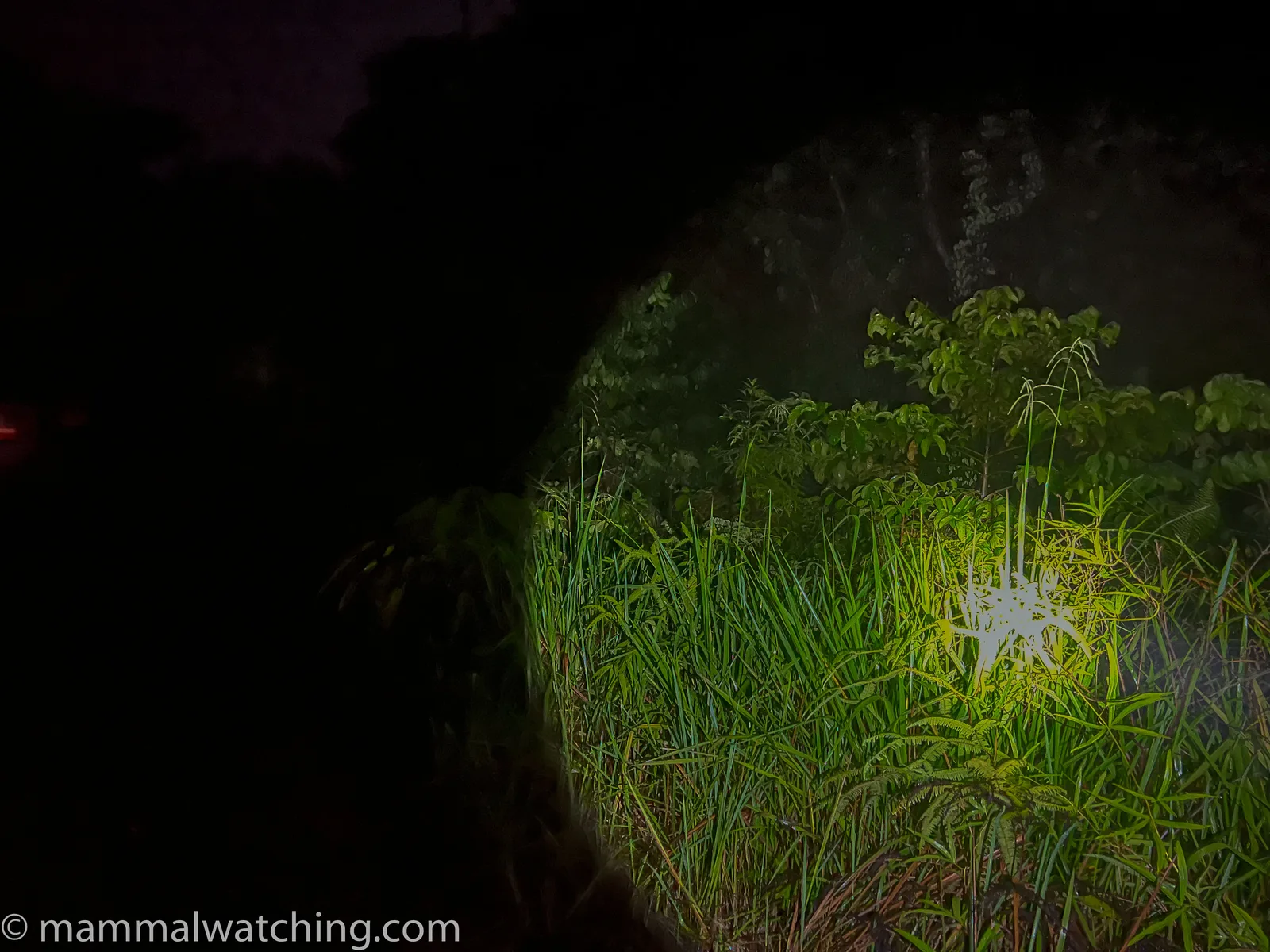
Not the cat itself — the Bay Cat had already vanished into the grass by the time this was taken. Deramakot Forest Reserve. Photo Jon Hall.
We spent nearly all our time driving up and down the same 30km of road that runs from the accommodation to the river. You start seeing animals very soon after leaving the headquarters area: we saw a Sun Bear just 3km along the road for instance. Once or twice we took the road out towards the entrance gate in the other direction. The forest looks just as good but for some reason isn't always as productive, though it was 10km along this road that we saw our Bay Cat.
The only walking I did was along the short Ecology Trail that runs behind the accommodation. This used to be a reliable area for Tarsiers. I tried several nights at different times but saw only a few bats and a colugo. Charles, Mike and I walked the road once in the early morning for three kilometres. This walk can usually turn up Maroon Langurs and Gibbons. We ran into a pair of Yellow-throated Martens.
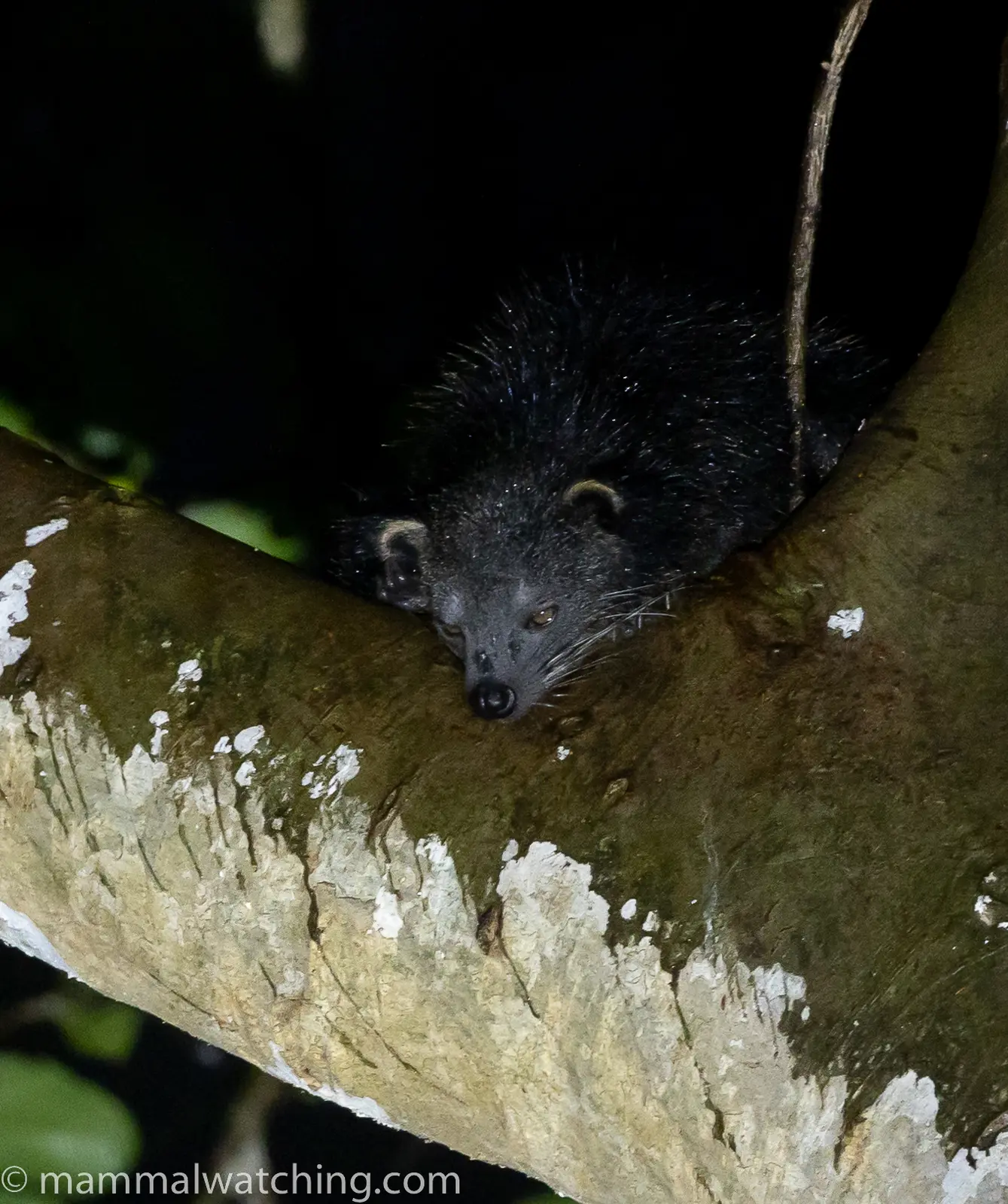
Binturong, Deramakot Forest Reserve. Photo Jon Hall.
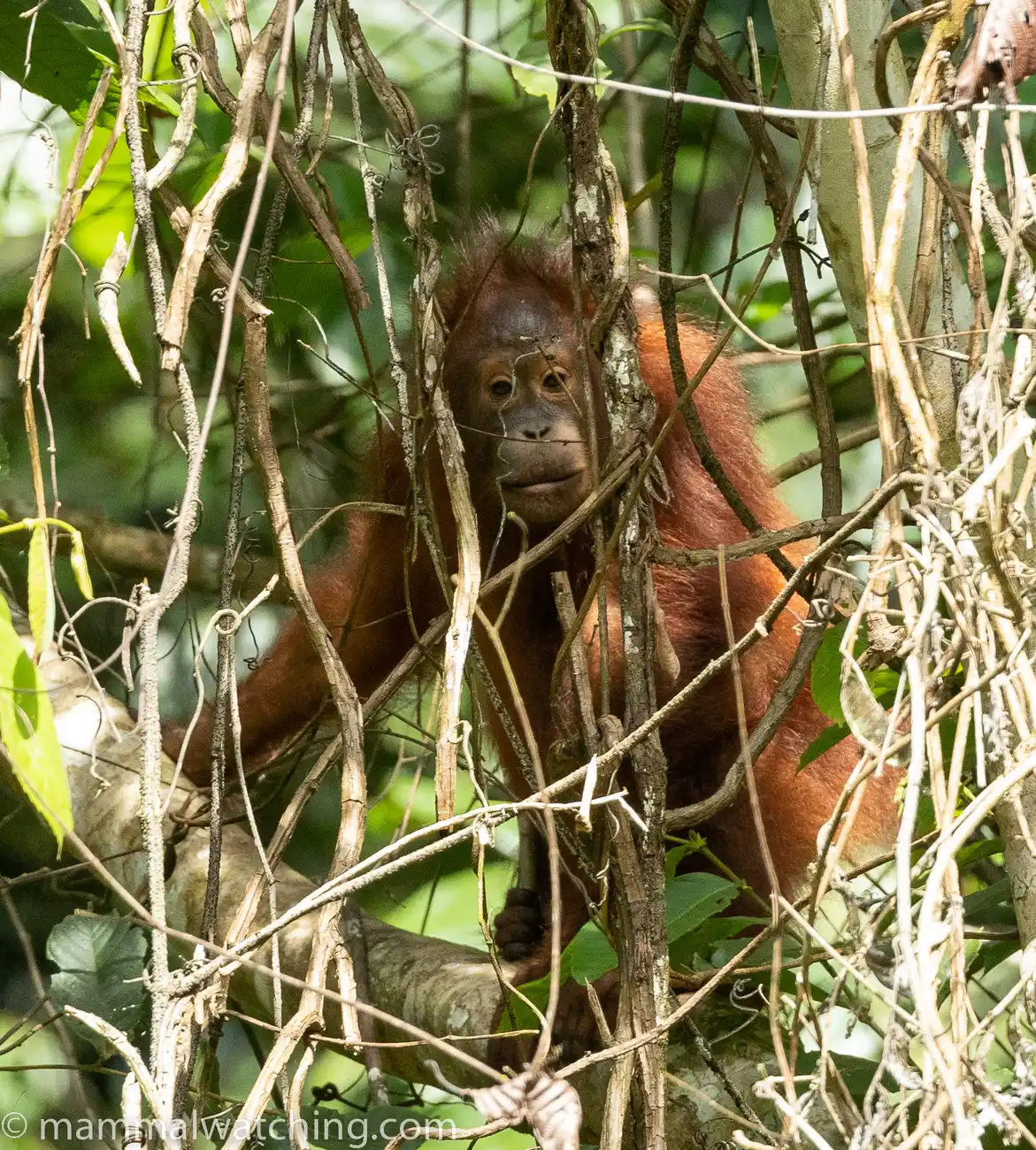
Bornean Orangutan, Deramakot Forest Reserve. Photo Jon Hall.
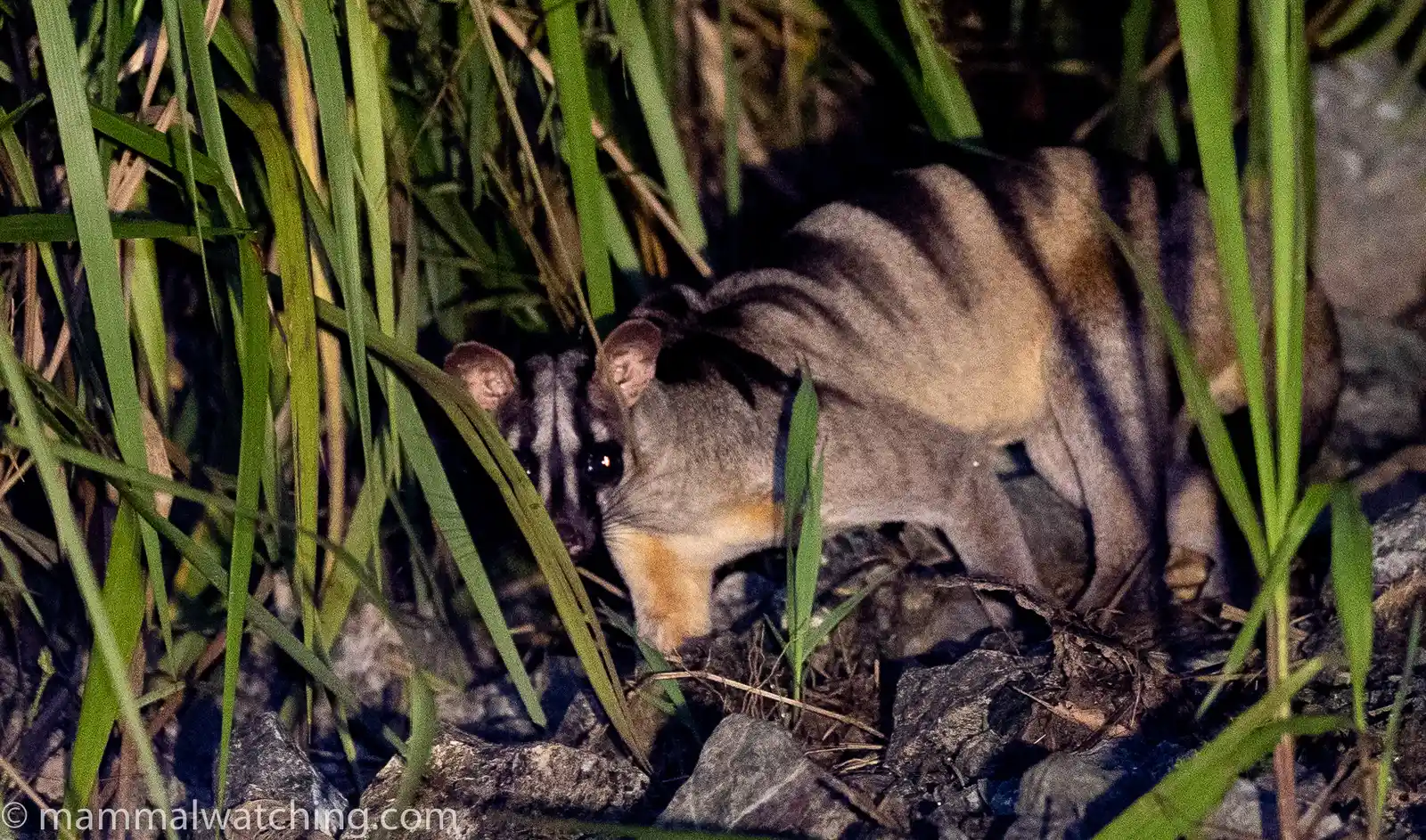
Banded Civet, Deramakot Forest Reserve. Photo Jon Hall.
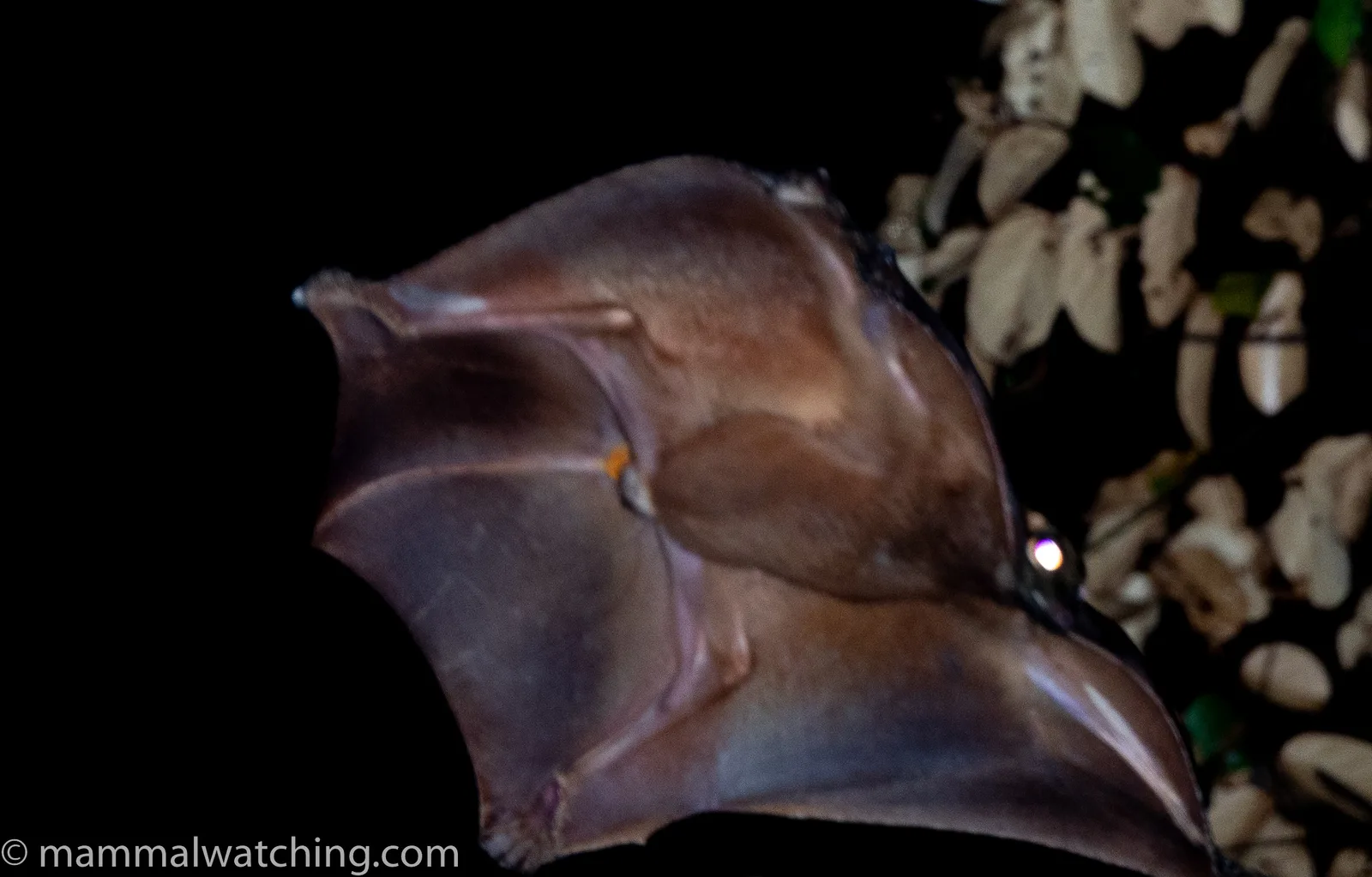
Sunda Colugo in flight, Deramakot Forest Reserve. Photo Jon Hall.
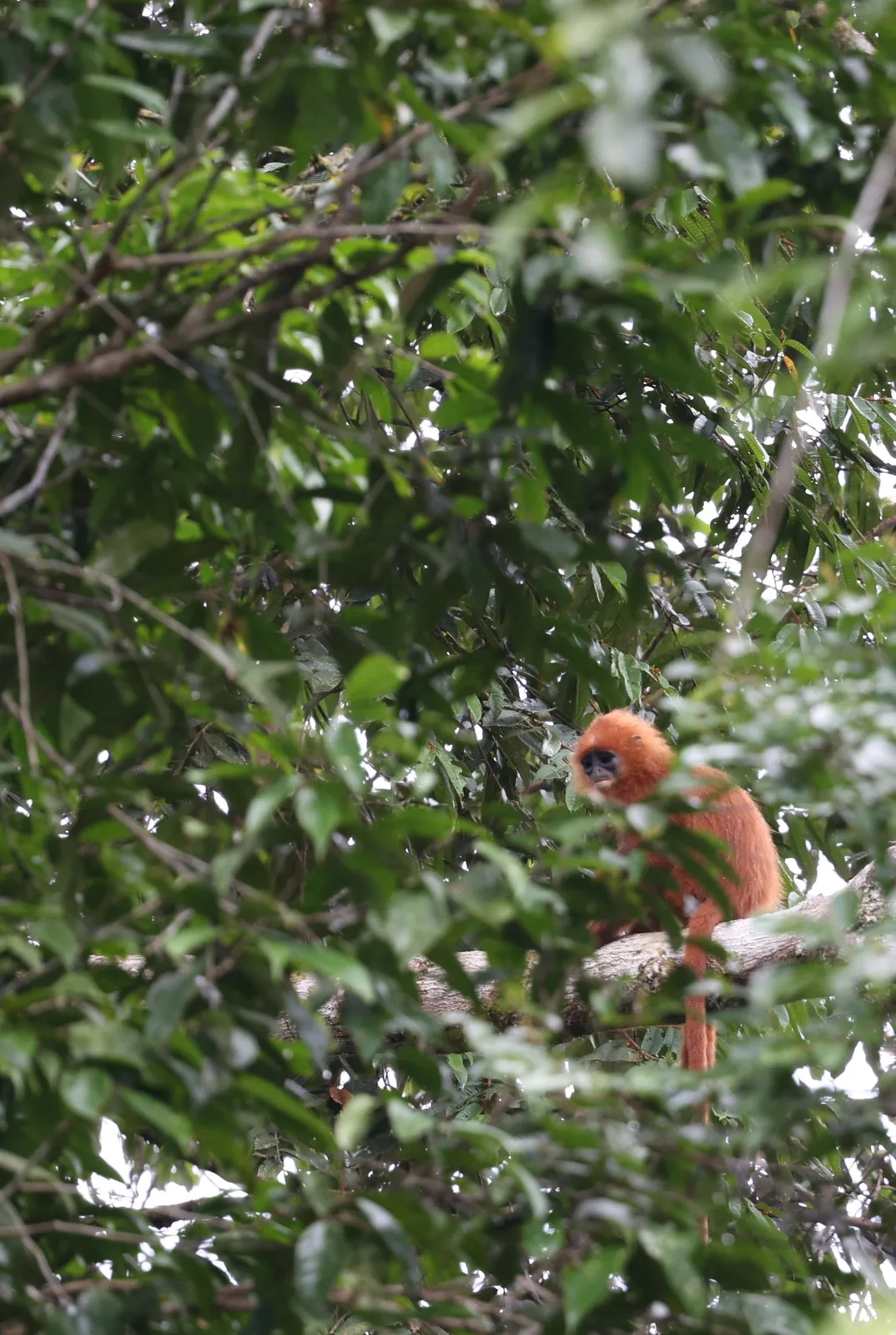
Maroon Leaf Monkey, Deramakot Forest Reserve. Photo Ian Thompson.
Mount Kinabalu National Park
I visited Mount Kinabalu in 2004 and promised myself I would return. Based on recent reports the park may be one of the better places to see a Banded Linsang (both Fiona Reid's 2017 trip and Tomer's 2019 visit recorded them). It is also the squirrel capital of the world with several species we all wanted to see together with (seemingly remote) chances of a Marbled Cat and a Kinabalu Ferret Badger. We spent three nights here.
Accommodation and Food
There are a few hotels just outside the park but we stayed in the park headquarters. The hotel here is popular and it took AA Borneo a while to find us all rooms. I gather it is also fairly expensive by Borneo standard. But the rooms are really lovely: this hotel could be a solid choice for a mammalwatching honeymoon. When we checked in there were various exclamations of "Oooh .. you have to come see my room".
The food did not live up to the decor. Breakfast was good but our full board package came with the hotel's set menu. And the hotel took the idea that set menu meant set in stone. After the fourth meal of rice, pepper beef and lemon chicken (all of which had had all the flavour surgically extracted) the a la carte menu became irresistible. A splinter group started paying extra for cheeseburgers (which the hotel eventually offered in lieu of the set menu). Consider going a la carte if you stay.
The Mammalwatching Set Up
Mammalwatching at Kinabalu focussed on the 3.5km of road that leads from the accommodation to the Timpohon Gate. In 2004 the rangers let me walk past the gate and up the mountain for a few kms alone and without any fee. I just promised I wasn't going to the top. Now it is much more regulated … we could not even sit on the other side of the gate without paying for a guide to take us to the summit. Luckily there isn't really much need, from a mammalwatching perspective, to go any beyond the gate.
More problematic is a recent change in the park's road rules. A few months ago a road barrier was set up at the bottom of the hill, next to the accommodation. The only way to drive up the road now is by taxi. This was the biggest frustration of the trip as it meant all our spotlighting — and Linsang searching — had to be done on foot. I suspect being on foot makes it harder to see a Linsang in any case, but it also cut down considerably on how many times we could go up and down the road looking for stuff.
The hill is steep so we decided to take a taxi up and walk back down. At first we were told that we could only get a taxi up the hill before 3pm. This got later each day and by the last day our taxi driver was ready to drive us up to the top at 7pm, which meant we had time to eat dinner and walk down slowly, rather than rush down to eat at 9pm before the kitchen shut.
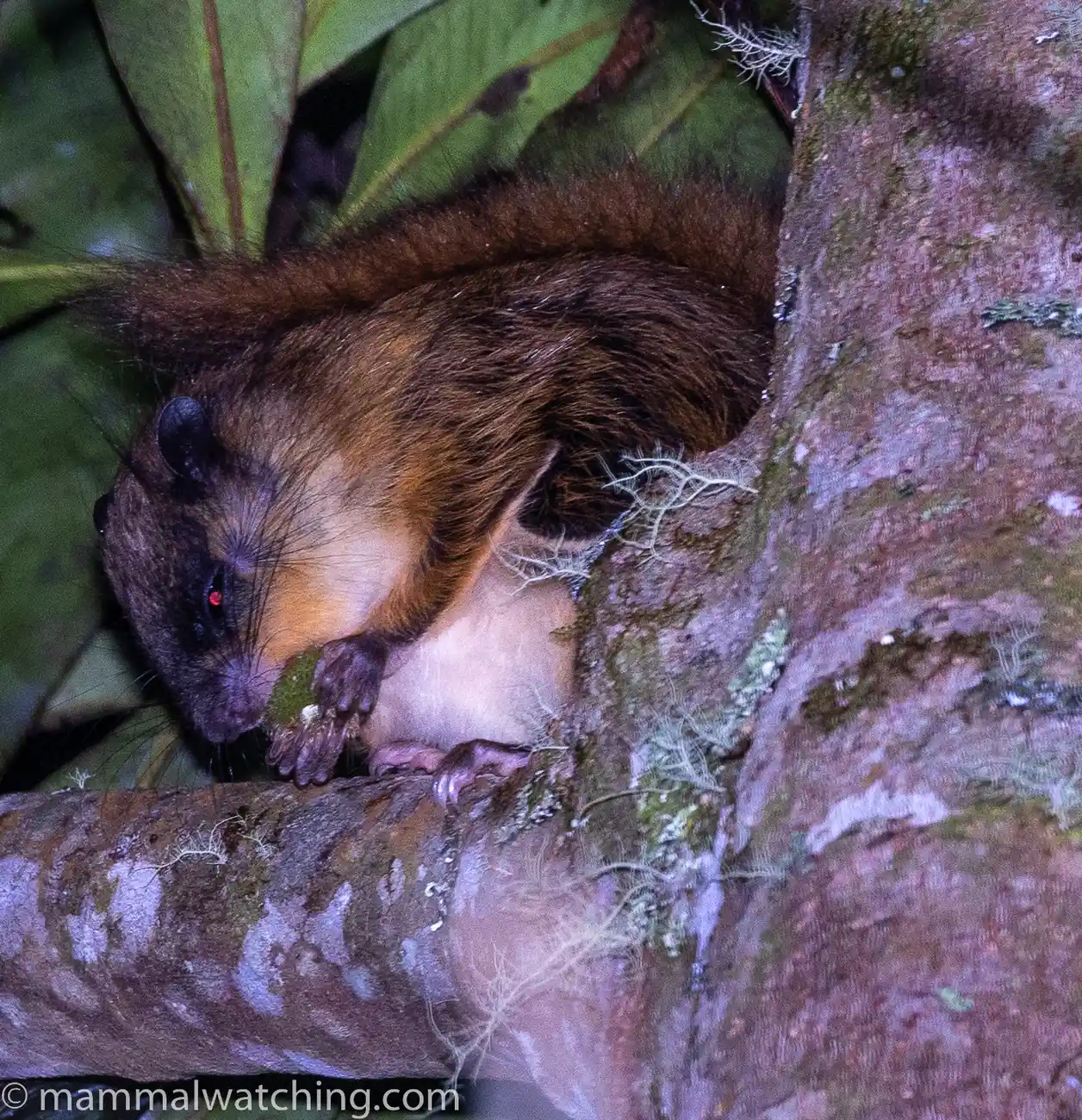
Whiskered Flying Squirrel, Mount Kinabalu National Park. Photo Jon Hall.
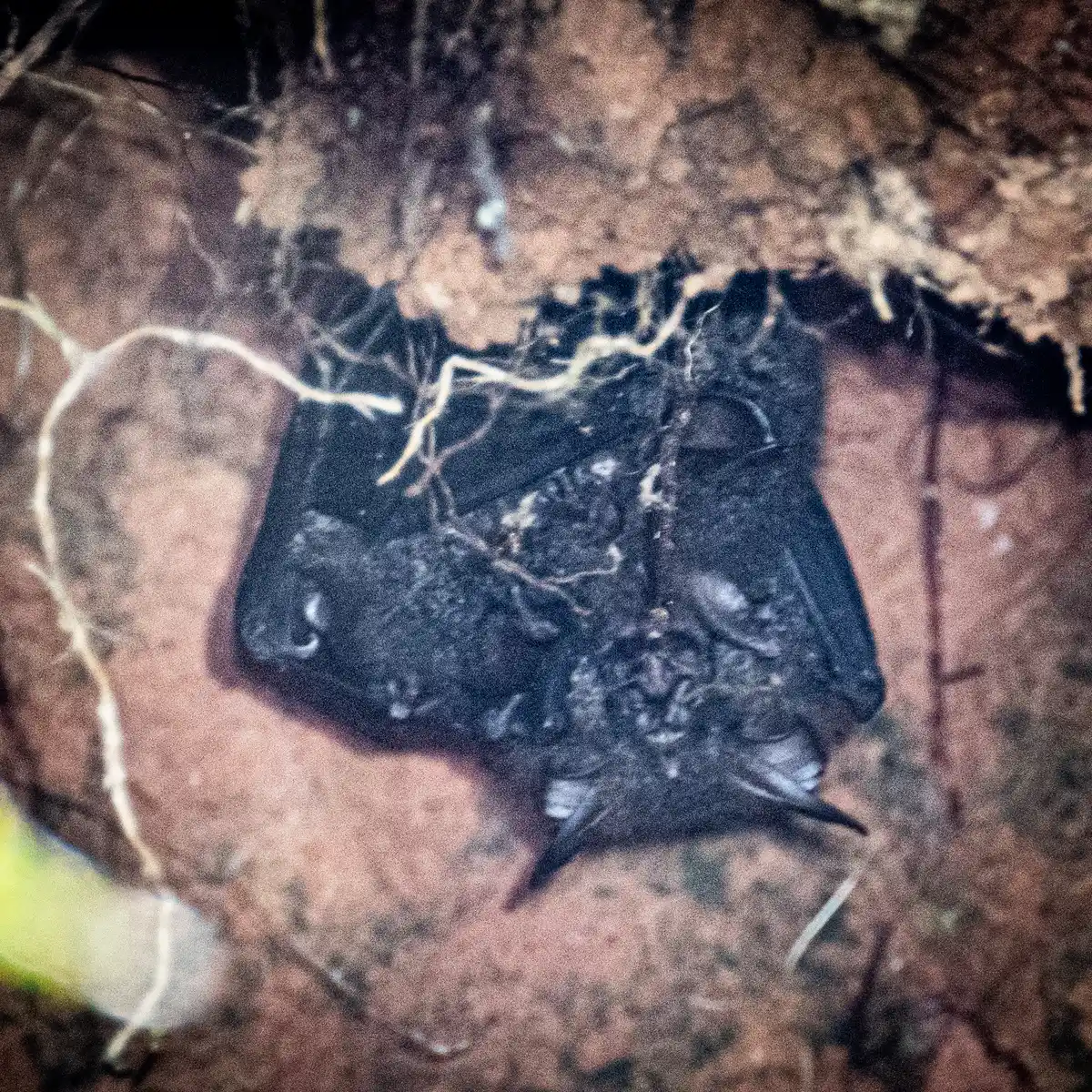
Andersen's Woolly Horseshoe Bat, Mount Kinabalu National Park. Photo Charles Hood.
During daylight the road itself was not all that productive. The area immediately in front of our rooms was one centre of squirrel activity, as was the area around the Timpohon Gate at the top of the road (and after dark the rats took over from the squirrels). A dumpster at the end of the road was one hot spot, as was the area around the pedestrian gate too. Spotlighting on foot down the road produced Spotted Giant Flying Squirrels and Striped Palm Civets all three nights plus a Whiskered Flying Squirrel. But no Banded Linsang.
Sayap Substation
Sayap Substation is also on Mount Kinabalu but on the north side. Probably only 40km or so as the hornbill flies from the park headquarters, it is a 2.5 hour circuitous drive. The forest altitude here is up at around 1000 metres. It is seldom visited by mammalwatchers but Sophie and Manuel Baumgartner saw everyone's favourite squirrel — the Tufted Ground Squirrel — here in 2019. Mike Gordon reckoned there was as much chance of us seeing one here as anywhere else easily accessible, so we thought we would give it a shot for a couple of nights.
Food and Accommodation
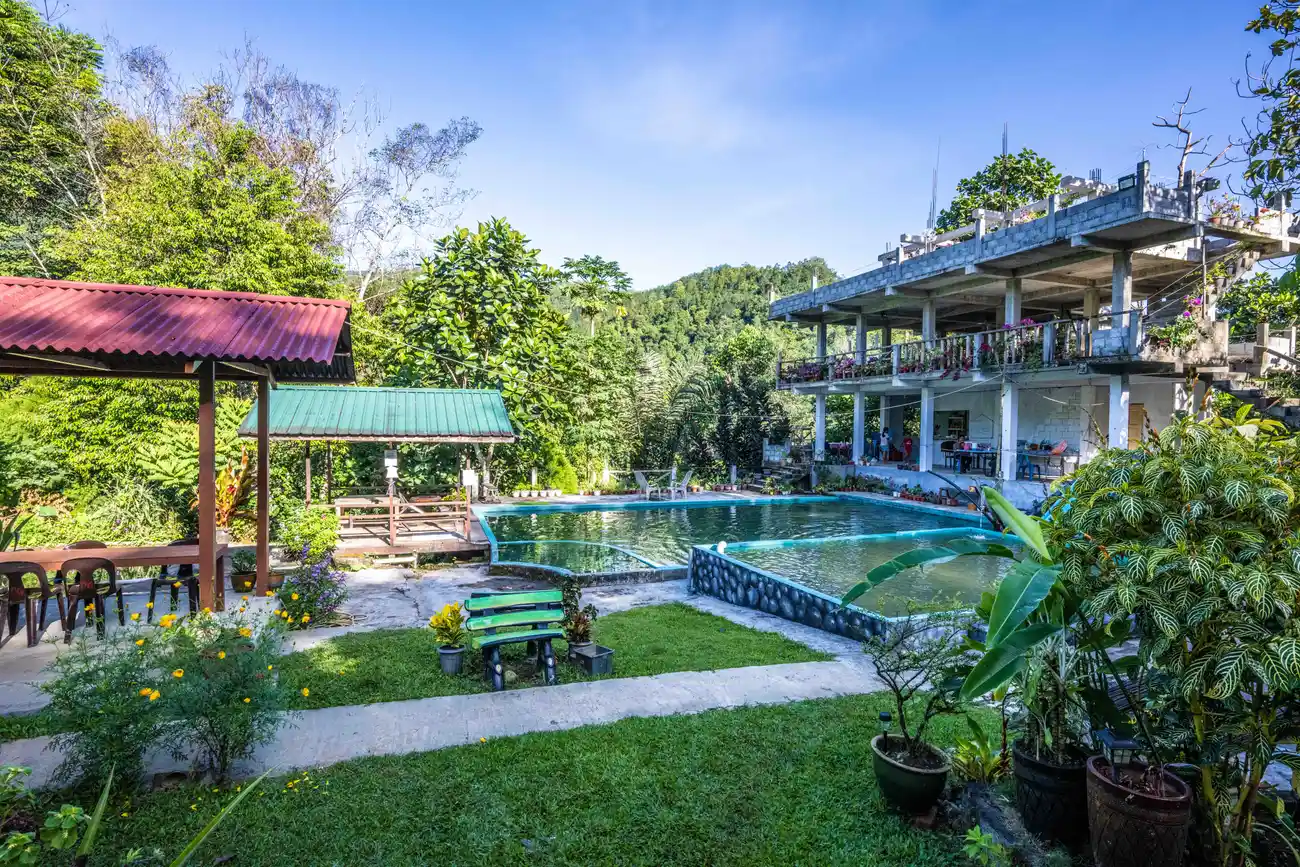
Porohon Garden Homestay, near Sayap Substation. Photo Charles Hood.
We stayed at the simple Porohon Garden Lodge homestay, about 40 minutes drive from the park. It is clean and comfortable and the food tasty. It comes with its own swimming pool, fed by a hosepipe from the river running through the gardens.
The Mammalwatching Set Up
The Sayap Substation has a network of trails. Most of them are steep, narrow and slippery so not ideal for mammalwatching as you had to spend your time looking at your feet rather than around you.
A disused road leads up the hill for a kilometre or so from the office and we spent all our time on that. The first 300 metres were very steep but it was at least wide enough to allow us to walk next to each other. An enormous tree, two hundred metres up the road, was alive with squirrels of multiple species on our first morning and we spent time here, taking plastic chairs up on the second morning so we could squirrel-spot in something approaching comfort. The ranger told us, as we were leaving, that he had seen Tufted Ground Squirrels "many times" crossing the trail near to this tree. So we were in the right area even though we didn't see a Tufted Ground Squirrel.
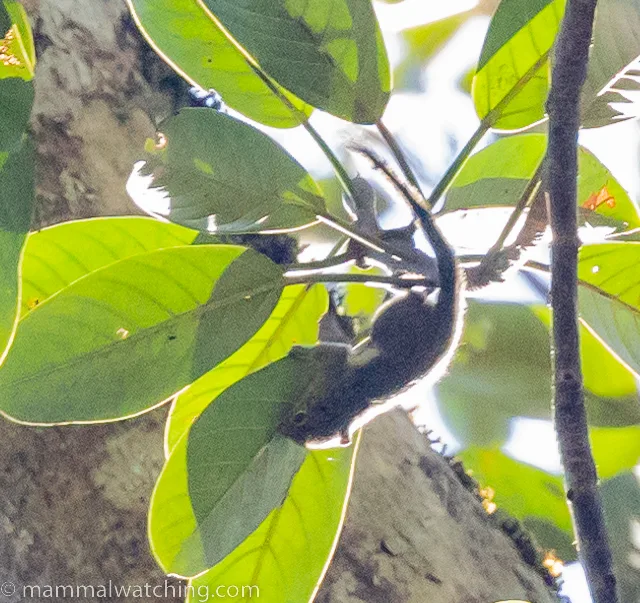
Sculptor Squirrel, Sayap Substation. Photo Jon Hall.
I glimpsed a tree shrew in Deramakot but have no idea which species. Ian Thompson saw another on Sayap which was possibly a Lesser Treeshrew. Charles Hood saw a shrew, possibly a Bornean Shrew, in the botanic gardens on Mount Kinabalu.
Stuff We Missed
This trip was built around 6 target species: Sun Bear, Clouded Leopard, Marbled Cat, Otter Civet, Banded Linsang and Tufted Ground Squirrel. We only saw the Sun Bear. Though in truth if we had thought there was even a remote chance of seeing a Bay Cat then that would have been on our target list too.
Clouded Leopard and Marbled Cat are still around Deramakot. Both were seen just before we arrived and soon after we left. Mike does not believe there is any strategy you can use to maximise your chances of seeing these species other than spending time on the Deramakot roads and hoping for the best. That sounds about right to me. There are chances for both species in the Danum or Tabin for sure, but are the chances any better?
Mike tried very hard to find us an Otter Civet. There are several good spots in Deramakot where he sees them quite often — small ponds or drainage ditches along the roadside — and if we had had more rain I suspect we might have gotten lucky.
I imagine Banded Linsang are still on Kinabalu but now that the road is closed to private vehicles I suspect they are going to be much more difficult to spot if mammalwatching has to be done on foot.
Seeing a Tufted Ground Squirrel in Sayap in two days was always a long shot. They are not abundant. Having it as a target species has brought it more into focus for future trips at least.
Most of us were also very keen to see a Sunda Pangolin, which are seen occasionally in Deramakot. One group saw one while we were there (during an afternoon drive into the park). And Ian and I tried to see Tarsiers several times along the Ecology Trail in Deramakot and briefly along a trail in Sayap where they have been reported. Night walks at the Sepilok Orangutan Rehabilitation Centre might be a reliable way to see this species.
Thank You
A huge thanks to Mike Gordon for all his hard work and good humour and to our tireless Deramakot team: our driver Andy and the talented kitchen staff. Thanks also to Tom and Nick from AA Borneo for setting it all up and to my fellow mammalwatchers for their spotting skills and good company.
Adapted with permission from Jon Hall's original report at mammalwatching.com.
Enquire about this trip ›Full species list
52 mammal species were recorded on this trip, with 13 lifers for the group. Names link through to their species pages.
Mammals (52)
- Bornean Elephant
- Sunda Giant Squirrel
- Whitehead's Pygmy Squirrel
- Brooke's Squirrel
- Bornean Mountain Ground Squirrel
- Jentink's Squirrel
- Sculptor Squirrel
- Plantain Squirrel
- Bornean Black-banded Squirrel
- Prevost's Squirrel
- Horsefield's Flying Squirrel
- Whiskered Flying Squirrel
- Spotted Giant Flying Squirrel
- Red Giant Flying Squirrel
- Black Flying Squirrel
- Thomas' Flying Squirrel
- Large Pencil-tailed Tree Mouse
- Lesser Ranee Mouse
- Long-tailed Mountain Rat
- Kinabalu Rat
- Asian House Rat
- Long-tailed Giant Rat
- Grey Tree Rat
- Mountain Treeshrew
- Sunda Colugo (Flying Lemur)
- Philippine Slow Loris
- Long-tailed Macaque
- Southern Pig-tailed Macaque
- Red Leaf Monkey (Maroon Langur)
- Northern Grey Gibbon
- Bornean Orangutan
- Ratanaworabhan's Fruit Bat
- Short-nosed Fruit Bat (sp.)
- Large Flying Fox
- Acuminate Horseshoe Bat
- Diadem Roundleaf Bat
- Andersen's Woolly Horseshoe Bat
- Trefoil Horseshoe Bat
- Bornean Bay Cat
- Sunda Leopard Cat
- Malay Civet
- Bornean Striped Palm Civet
- Binturong
- Island Palm Civet
- Banded Civet
- Sun Bear
- Sunda Stink Badger
- Yellow-throated Marten
- Greater Mouse-deer
- Bornean Yellow Muntjac
- Sambar Deer