 Wildlife
of Borneo
Binoculars
What Binoculars Should You Buy? A Practical Buying Guide
Choosing binoculars comes down to a handful of decisions — magnification, lens size, weatherproofing and budget — that apply whether you're watching garden birds at home or tracking wildlife through Borneo's rainforest canopy. This guide covers both: the general buying advice that answers the questions everyone asks, and the specific picks that hold up in the toughest environment there is.
The short answer
For most people, an 8x42 pair with ED glass and full waterproofing is the safest choice — enough magnification for real detail, a wide enough field of view to track moving animals, and rugged enough for regular outdoor use. Budget $150–500 for a genuinely good general-purpose pair; below about $100, low-light performance and sharpness usually disappoint. The rest of this guide explains why, and points to specific models at every budget.
Borneo raises the bar
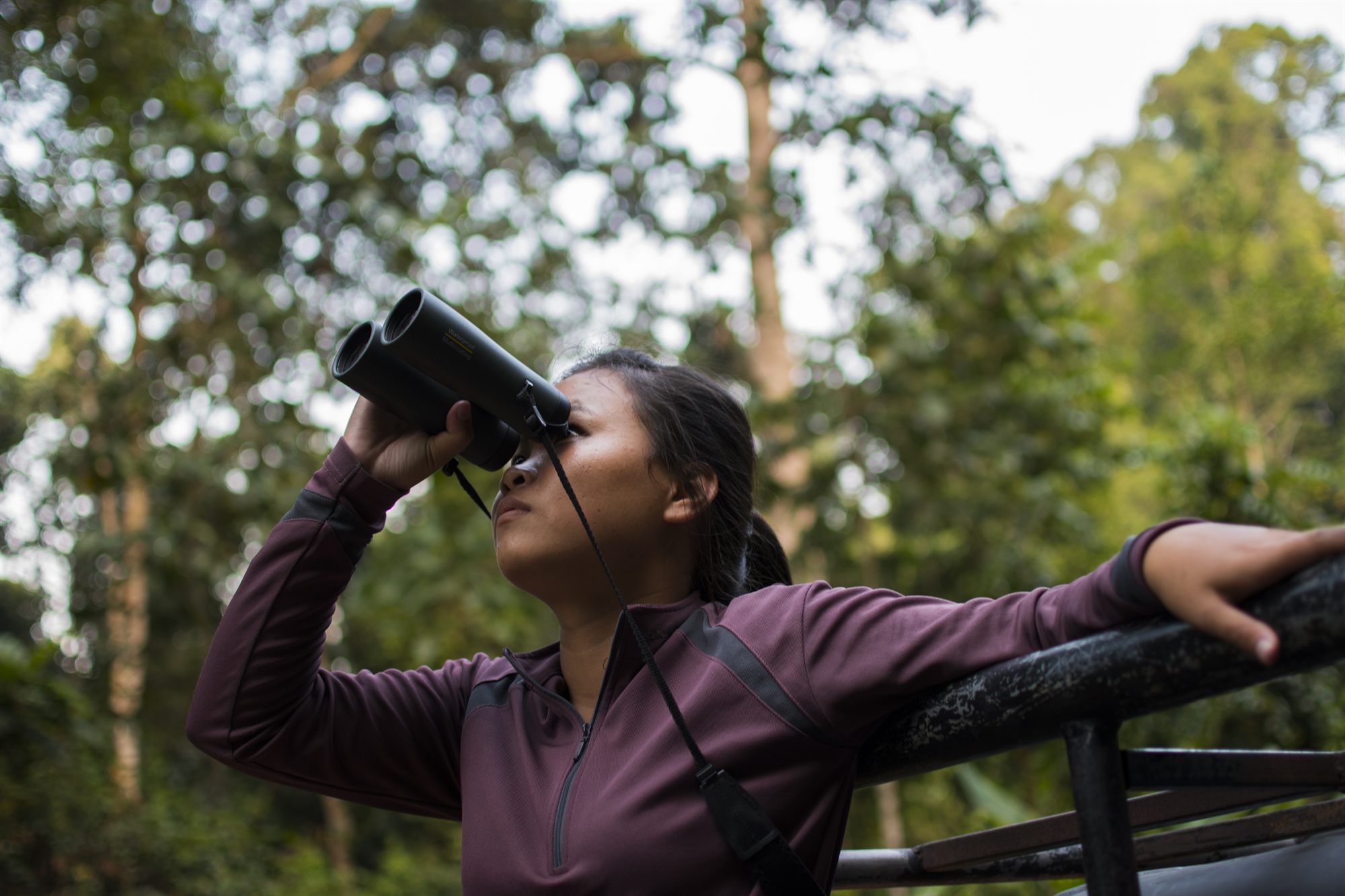
Borneo's rainforests are home to some of the most extraordinary wildlife on Earth — from canopy-dwelling orangutans and proboscis monkeys to elusive Bornean pygmy elephants and over 600 species of birds. But observing wildlife in a dense tropical environment presents unique optical challenges: low light under the canopy, high humidity, frequent downpours, and fast-moving targets hidden high in tall dipterocarp trees. Everything below still applies wherever you're buying for — Borneo just has zero tolerance for a binocular that gets any of it wrong.
Having the right pair of binoculars can mean the difference between seeing a distant shadow and locking onto the vibrant plumage of a Helmeted Hornbill or the subtle markings of a Hose's Langur.
What makes Borneo's environment unique for optics?
Before buying optics for a trip across Sabah, Sarawak or Kalimantan, consider these environmental factors:
- Low light conditions. The thick rainforest canopy blocks up to 90% of direct sunlight. You need optics with high light transmission, especially during early morning hikes or dusk river cruises along the Kinabatangan River.
- Extreme humidity and rain. Borneo's tropical climate causes instant internal fogging and optic failure if your gear isn't fully sealed against moisture.
- High canopy heights. Wildlife frequently stays 30–50 metres above the ground in massive trees. You need enough magnification to pull in detail without sacrificing image stability or field of view.
Key specifications to look for
- Objective lens diameter (42mm recommended). Larger objective lenses let more light reach your eyes. Compact 25mm or 28mm binoculars produce dim, grainy images in shadowy underbrush — stick to 8x42 or 10x42.
- Magnification: 8x vs. 10x.
- 8x: A wider field of view, a brighter image, and easier hand-stabilisation — ideal for tracking fast-moving birds or primates jumping through branches.
- 10x: Extra reach for spotting distant wildlife on opposite riverbanks or high in tree hollows, though it needs a steadier hand.
- Waterproofing and fogproofing (essential). Make sure optics are O-ring sealed and nitrogen- or argon-purged. Humidity causes internal moisture buildup on non-sealed binoculars, leading to permanent mould growth.
- Glass quality and coatings. Look for Fully Multi-Coated (FMC) lenses and ED (Extra-low Dispersion) glass, which reduces chromatic aberration (colour fringing) — critical when viewing a dark silhouette against a bright, backlit jungle canopy.
Top binocular recommendations by budget
Rough street prices in USD, current as of late 2026 — actual prices vary by retailer and region, so check current pricing before buying.
Budget tier: high value and reliability
- Svbony SV202 ED (8x42) — approx. $100–130: A standout budget performer featuring true ED glass. It controls colour fringing exceptionally well when staring up into bright sky gaps through the trees.
- Nikon Prostaff P7 (8x42) — approx. $180–220: Extremely lightweight for long treks in places like Danum Valley or Maliau Basin. Fully waterproof and equipped with a locking diopter ring to keep your settings secure in the field.
Mid-range tier: the sweet spot for rainforest birding
- Athlon Midas G2 UHD (8x42) — approx. $400–450: A rugged magnesium alloy chassis that stands up to humid, rough travel. Excellent close-focus performance for inspecting nearby insects, amphibians and reptiles.
- Vortex Viper HD (8x42) — approx. $450–500: High-durability optics designed for river boats and dusty roads. Vortex's VIP unconditional warranty ensures repair or replacement if your gear takes an unexpected splash.
- Kowa BD II XD (8x42 WA) — approx. $450–500: An outstanding option for active birders. Its ultra-wide field of view makes scanning dense foliage for quick species like pittas, broadbills and babblers much easier.
Premium tier: flawless optical clarity
- Zeiss Conquest HD (8x42) — approx. $900–1,000: Renowned for low-light performance under deep canopy shade. Its proprietary LotuTec® water-repellent coating makes raindrops bead up and roll off without smudging your view.
- Leica Ultravid / Noctivid (8x42) — approx. $1,800–2,900: Industry-leading contrast and colour rendering that cuts through visual clutter to identify subtle field marks on distant mammals and camouflaged birds. Ultravid sits at the lower end of that range, Noctivid at the top.
- Swarovski NL Pure (8x42) — approx. $2,700–3,000: The pinnacle optic. Exceptional light-gathering power stretches viewing time into late twilight along the river, with class-leading ergonomic comfort for long field days.
Common binocular buying questions
What binoculars should I buy?
For most people, an 8x42 pair with fully multi-coated lenses, ED glass and O-ring waterproofing is the safest all-round choice — enough magnification to see real detail, a wide enough field of view to track moving wildlife, and rugged enough for regular outdoor use. Budget $150–500 for a genuinely good general-purpose pair; below about $100, low-light performance and image sharpness usually disappoint.
What do the numbers on binoculars mean, like 8x42?
The first number is magnification — 8x means an object appears 8 times closer than to the naked eye. The second number is the objective lens diameter in millimetres, the size of the front lens, which controls how much light reaches your eye. A larger objective lens means a brighter image, especially at dawn, dusk or under tree cover.
Should I buy 8x42 or 10x42 binoculars?
8x42 is the better all-round choice for most wildlife viewing: a wider field of view, a brighter image, and it's easier to hold steady, which matters for fast-moving subjects like birds or primates. 10x42 gives extra reach for distant, mostly stationary subjects — open landscapes, raptors on a wire, wildlife across a wide river — but the narrower field of view and extra hand-shake make it harder to use for anything moving quickly at close range.
How much should I spend on binoculars?
Roughly three tiers. $100–200 gets a usable entry-level pair, fine for casual use but weaker in low light. $400–600 is the real sweet spot for serious wildlife watching — genuine ED glass, better coatings and durable, fully sealed builds. Above $900, you're paying for edge-to-edge sharpness, low-light performance and ergonomics that matter most to dedicated birders and photographers, with steeply diminishing returns for casual use.
Are expensive binoculars actually worth it?
Past the $400–600 mid-range, more money buys incremental gains — brighter low-light images, sharper edges, lighter builds and better warranties — rather than a fundamentally different experience. A well-chosen mid-range pair with ED glass and proper waterproofing handles the vast majority of wildlife viewing; premium optics mainly matter for professionals and enthusiasts pushing performance in the hardest conditions, like deep forest shade at dawn.
What's the most important binocular spec for wildlife viewing?
Waterproof, fogproof sealing — O-ring sealed and nitrogen- or argon-purged — matters more than almost any other spec, since a fogged or moisture-damaged pair is useless regardless of glass quality. After that, ED (Extra-low Dispersion) glass has the biggest impact on real-world image quality, reducing the colour fringing that shows up around backlit branches, feathers and fur.
Field tips for optics in Borneo
- Acclimate your gear. Moving from air-conditioned hotel rooms or vehicles straight into humid tropical air causes immediate external fogging. Let your optics acclimate in their case for 15 minutes before starting your walk.
- Use a harness. Neck straps strain your neck during hours of canopy scanning. A binocular chest harness keeps optics secure against your chest and accessible while distributing weight across your shoulders.
- Carry microfiber and sealed storage. Tropical moisture is persistent. Keep a clean microfiber cloth inside a Ziploc bag, and store your optics in a dry bag during riverboat transfers or unexpected squalls.
If you're planning where to put these to use, the birdwatching guide and mammal watching guide cover the parks, canopy walks and river routes where good glass makes the biggest difference.